Samsung Galaxy Z Fold 5 Review – The best foldable for productivity - Mighty Gadget
I have loved the idea of foldable phones since they were introduced with the original Fold and the Huawei Mate X back in 2019.
It has taken me a few years to commit to one as the high price has been off-putting, durability is a concern, and camera quality and battery life are essential to me.
With the fifth generation of the Samsung Galaxy Z Fold, I finally decided to commit to buying a foldable.
The Pixel Fold may have been a more interesting choice as it is a brand-new product from Google. The Samsung Galaxy Z Fold 5 is very much an iterative upgrade from the Samsung Galaxy Z Fold 4, but I felt that Samsung has the most experience with foldables. If I am parting with my own money, I want the best experience possible.
Key Features
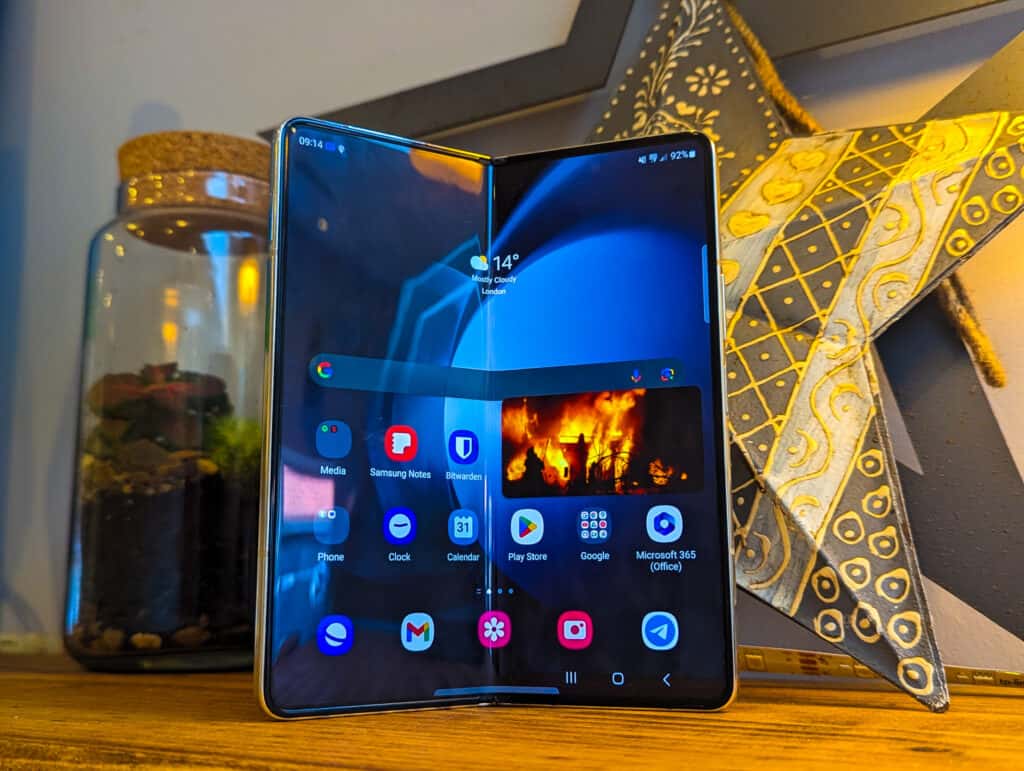

The Samsung Galaxy Z Fold 5 is packed with an array of cutting-edge features:
- A large 7.6-inch foldable internal display gives you a display that's almost the same size as a small tablet.
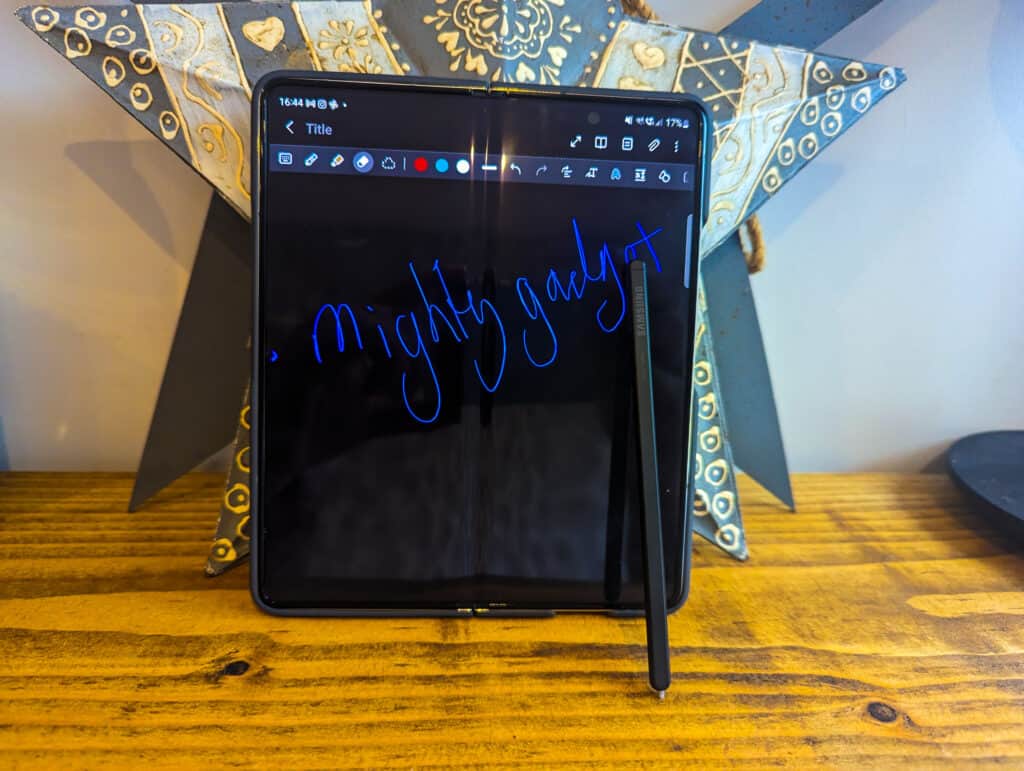
- Various software functions such as multi-tasking, split screen support, and S Pen support.
- Flagship performance thanks to the Qualcomm Snapdragon 8 Gen 2 chipset, which has also been tweaked specifically for Samsung.
- Versatile rear camera setup.
- Improved durability compared to previous generations with an IPX8 rating, a new, more durable hinge and folding closed completely flat.
Samsung Galaxy Z Fold 5 vs Samsung Galaxy Z Fold 4 Specification
When comparing the Z Fold 5 with its predecessor, the Z Fold 4, the differences are quite subtle. The most notable upgrade is the redesigned hinge mechanism that allows the Z Fold 5 to fold completely flat, eliminating the gap present in previous iterations. Additionally, the Z Fold 5 is marginally lighter and thinner, and the foldable display is 30% brighter, making for a more comfortable viewing experience.
Performance-wise, the Z Fold 5 features an upgraded Snapdragon 8 Gen 2 processor, offering better speed and battery efficiency compared to the Z Fold 4's Snapdragon 8 Gen 1 chip. It is also a little bit better than the Snapdragon 8 Gen 2, with the "for Samsung" chip having the main X3 core clocked higher at 3.36GHz.
Samsung Galaxy Z Fold 5 vs Google Pixel Fold
The Galaxy Z Fold 5 and Google Pixel Fold are two of the most popular foldable smartphones on the market, and both phones have a similar price point.
The main reason I opted for the Samsung Galaxy Z Fold 5 was that I felt Samsung have more experience with foldable, and this phone will hopefully have fewer glitches.
From a hardware perspective, they are closely matched.
Both the Galaxy Z Fold 5 and Google Pixel Fold sport 7.6-inch inner displays that run at a similar resolution. However, Samsung uses an under-display selfie camera, whereas the Pixel has a relatively large bezel running around the edge of the display. This makes the Pixel larger when unfolded, being an extra 4mm high and 10 mm wide.
The Pixel has a shorter but wider 5.8″ display with a resolution of 1080 x 2092 pixels, giving an aspect ratio of 17.4:9. In contrast, the Samsung display is quite long and narrow, being 6.2″ running at 904 x 2316 pixels for a 23.1:9 aspect ratio.
While I have not used the Pixel Fold, I must admit the wider outside display looks more practical.
While the Google Pixel Fold boasts a larger battery within a thinner body, the Galaxy Z Fold 5 holds its own with a more robust hinge mechanism and superior multi-tasking capabilities.
Finally, as much as I love what Google does with UI and optimization of Android with both their phones and the Pixel Tablet, I think that Samsung DeX is potentially a big selling point for this phone. I view foldables of this nature as geared more towards productivity, and Samsung DeX provides some amazing options for when working away.
Design & Build Quality
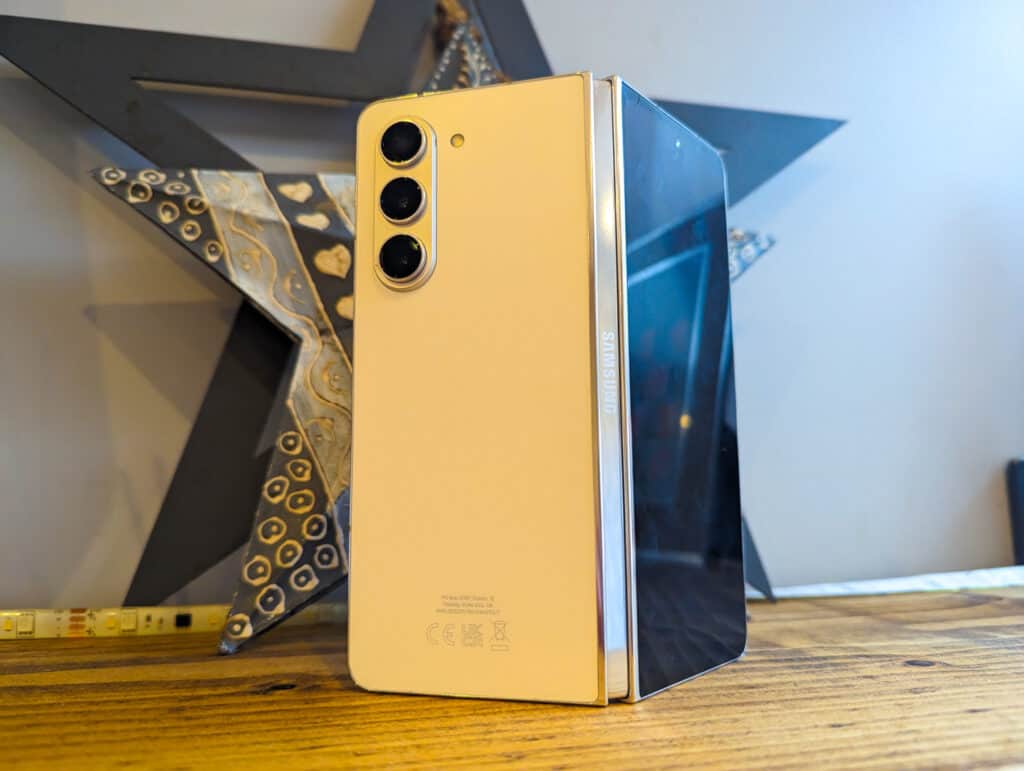
The Galaxy Z Fold 5 maintains a similar design to its predecessors, with a book-style foldable form factor. It's crafted with Samsung's Armor Aluminum material, with Gorilla Glass Victus 2 protection for the outer glass panels, ensuring durability. The new Flex Hinge mechanism is silent and perfectly dampened, enhancing the overall feel and usability of the phone.
It is undeniably a large and heavy phone, but it is perhaps not quite as big as I had expected. If you compare it to the Samsung Galaxy S23 Ultra, it is not significantly bigger:
- Samsung Galaxy Z Fold5
- Folded Dimensions: 154.9 x 67.1 x 13.4 mm
- Weight: 253 g
- Samsung Galaxy S23 Ultra
- Dimensions: 163.4 x 78.1 x 8.9 mm
- Weight: 234g
That being said, the extra 4.5mm in depth does make a significant difference. I have fond memories of my old Nokia Communicator E90, and I get the same vibes with this phone.
The phone is available in three colours, blue, black and cream. The blue was sold out when I bought it, and black is boring, so I opted for cream.
Internal and External Display
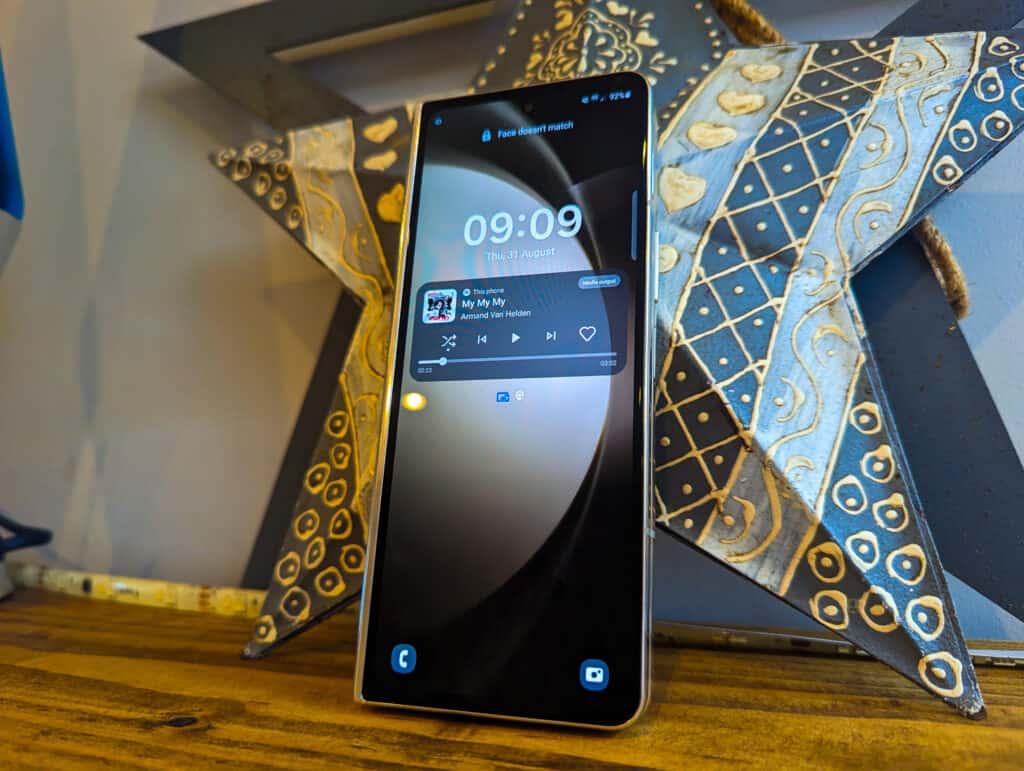
The Z Fold 5 features two displays: a tall-and-narrow 6.1-inch external display and a larger 7.6-inch foldable display on the inside. Both screens use a Dynamic AMOLED 2X panel and support a 120Hz refresh rate, providing a smooth and vibrant viewing experience.
At 6.1″, the front display sounds like it should be great and is generally good. But it is very narrow, and so far, I haven't used it for much other than basic phone functions like checking notifications etc. Perhaps I am still in the honeymoon period of enjoying opening up my phone to use its massive display.
The Pixel Fold and Honor Magic V2 have a wider external display, which I think would be more usable for general functions, though it is only about 180 pixels extra in width.
I have noticed conflicting views of the front display. Some people are adamant that it should only be used for the most basic of functions, others want the convenience of a more usable front display so you don't have to constantly unfold the phone for everything.
For now, I am happy using the internal display for most things; the one caveat of this is that I assume it will drain the battery faster.
For both displays, I have found the brightness and image quality to be outstanding. Samsung claims the 7.6-inch QXGA+ folding screen is now up to 30% brighter and can reach a peak brightness of 1,750 nits.
I have been using this phone during the recent heat wave, and I have had no problems using the phone outside in bright sunlight in the slightest.
Foldable Display Crease
One of the issues that is often raised with foldables is the crease down the display. Companies seem to be getting better at reducing this issue. I have seen people state that the new Honor Magic V2 has almost no crease at all, but I have also seen some pictures that look like it may have a crease.
As for the Samsung Galaxy Z Fold 5, there is no denying that there is a crease there. How much that bothers you will be subjective. When looking directly at the screen with it displaying something (which is the most likely scenario), the crease is not visible to me.
Looking at the display at an angle, it does become visible, and with the display not showing anything, it is very visible.
You can also feel the indentation. I found this was particularly noticeable when using the S Pen.
Biometrics – Face Detection & Side Mounted Fingerprint Scanner
The Galaxy Z Fold 5 offers reliable security features, including face detection and a side-mounted fingerprint scanner, ensuring your device is adequately protected.
I am really not a fan of side-mounted fingerprint sensors, but considering the dual-display design, there does not seem to be much of a logical alternative. Competing options all use a side-mounted sensor as well.
Face detection generally works well but will falter if there is not very good lighting when you are trying to unlock the phone.
Rear Cameras
The Z Fold 5 houses a triple camera setup at the back, consisting of a 50MP f/1.8 primary camera with OIS, a 12MP f/2.2 ultra-wide, and a 10MP f/2.4 3x telephoto shooter.
You then get 4K@60fps and 8K video recording, 3x optical zoom with up to 30x digital zoom, and AI-based object detection.
Like all foldables, the camera doesn't quite compete with traditional slab phones, and this is one of the things that has put me off foldables. I use the camera a lot for my work and travel, so a good camera has become increasingly important to me.
However, the performance is reasonably good, and it delivers high-quality photos, with ample detail, low noise, and good dynamic range.










Front Display Selfie Camera
The front display of the Z Fold 5 is equipped with a 10MP selfie camera that captures clear and vibrant selfies. The camera's intelligent features allow for improved picture quality, even in low-light conditions.
One of the advantages of foldables is the ability to use the main rear cameras for selfies and the out display as a viewfinder. This is a bit more awkward to use, but the 50MP sensor will provide far superior results than the 10MP selfie camera.
Under Display Camera
The Z Fold 5 also features a 4MP under-display camera on the inner screen. Despite its lower resolution, this camera is well-suited for video calls. I wouldn't really recommend it for selfies, especially as you have two superior alternative options.
Performance and Benchmarks
With the Snapdragon 8 Gen 2 for Galaxy chip and 12GB of RAM, the Z Fold 5 offers exceptional performance. Whether you're gaming, multi-tasking, or streaming videos, the device handles tasks smoothly and efficiently.
Like all flagship phones nowadays, the performance is flawless in everything I tested this on. While I am normally indifferent to fast refresh rates on phone displays, it does seem to help with the internal display on this phone. The smoothness of the navigation is much more noticeable on a larger display.
As far as benchmarks go, the results are similar to other phones with the Qualcomm Snapdragon 8 Gen 2.
For the 3Dmark Wildlife stress test, the phone achieves a higher best loop score than my Honor Magic5 Pro and is about the same as the REDMAGIC 8 Pro. However, the stability is lower, indicating thermal throttling.
Out of curiosity, I ran the test on both the internal display and the outer. With the outer display, the best loop score was even higher, but so was the thermal throttling. I guess this makes sense, as there will be less heat dissipation with the phone folded.
For Geekbench V6, you can see the benefit of the X3 core, which is clocked 5.3% higher than the standard Snapdragon 8 Gen 2. For the single core result, this achieves a score of 2033, which is a 4.3% improvement over the Honor Magic5 Pro.
Software & Software Updates