Watch now: How Central Illinois polygraph examiners test the truth - The Pantagraph
Watch now: How Central Illinois polygraph examiners test the truth - The Pantagraph |
| Watch now: How Central Illinois polygraph examiners test the truth - The Pantagraph Posted: 30 Apr 2021 05:07 PM PDT 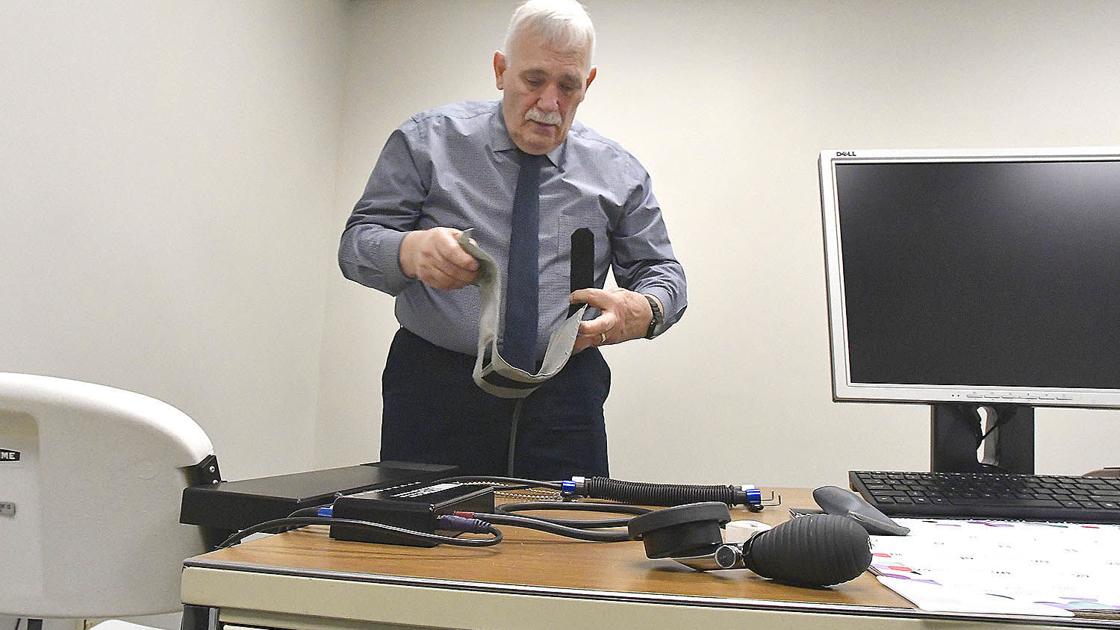 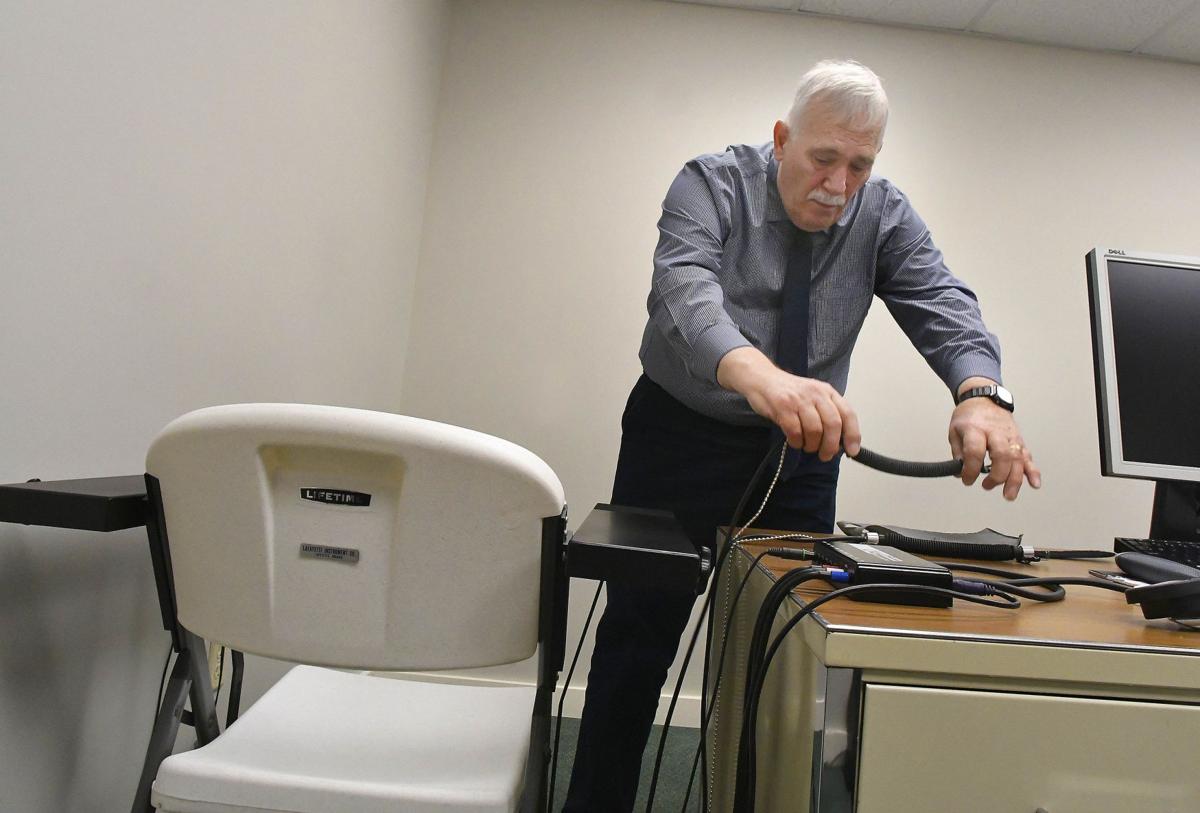 Central Illinois polygrapher Steve Woody prepares his equipment. The profession requires a state license. A knowledge of physiology and human behavior allow a polygrapher to measure truthfulness. BLOOMINGTON — An Illinois man accused Mars Inc. of placing a needle in his M&M's, causing a mouth injury. The FBI called in Mark Cheviron, a polygraph examiner from Decatur, to administer a lie detector test to find the truth. "It went all the way to federal court. I testified about that where he finally made admissions that he did it himself," said Cheviron, a former security director at Archer Daniels Midland who also worked with the Macon County Sheriff's Department. Cheviron is retired, but still holds a license and issues some tests. He's one of the few.  Cheviron The number of polygraph examiners entering the industry across the United States has plummeted since the 1990s. There are just 63 registered in Illinois, according to the state Department of Financial and Professional Regulation, which issues licenses. Today, the tests are most often given to law enforcement officers applying for jobs, as well as those seeking federal security clearances. Some police agencies also use polygraphs when interrogating suspects, although that too has changed.  A blood pressure cuff and parts of pneumographs are used by Steve Woody, a polygrapher and owner of All Purpose Polygraph in Bloomington. While most polygraph jobs are full-time careers with a median yearly salary of around $58,000, it's a challenging line of work to get into, said Steve Woody, of All Purpose Polygraph in Normal. "There really aren't a lot of polygraph examiners left in Illinois because we're a difficult state to license in," he said. Still, there is a client base out there hungry for the truth, he said. 'Detection of Deception' licenseWilliam M. Marston invented the lie detector in 1917, based on the premise that a rise in blood pressure could determine if someone was telling the truth. Along the way, they've become mainstays of crime dramas, as well as devices in movie plots from "Dead Man Walking" to "Meet the Parents." In fact, Woody administered a polygraph test on Matt Damon in "The Informant!" filmed in Decatur. Vice President Mike Pence volunteered to take a lie detector test to prove he didn't write an anti-Trump op-ed in The New York Times in 2018. Former U.S. House Rep. Gary A. Condit took one in connection with the disappearance of Chandra Ann Levy in 2001. The devices were a topic in the confirmation of Brett Kavanaugh to the U.S. Supreme Court. A blood pressure cuff and parts of pneumographs are used by Steve Woody, a polygrapher and owner of All Purpose Polygraph in Bloomington. Modern tests today measure heart rate, breathing and galvanic skin response, but the setup has also been challenged for its legitimacy and accuracy. The Supreme Court has ruled that lower courts can ban tests as evidence. Arthur Beier, a retired examiner from Mattoon, said the accuracy of the results depends heavily on the questions asked, and that depends on the examiner.  Steve Woody, a polygrapher and owner of All Purpose Polygraph in Bloomington, prepares sensors. "An important part of polygraph is using the language that the individual uses. You need to be able to formulate your questions on his or her level," said Beier. Before beginning a polygraph, the examiner will come up with specific questions to the topic, called relevant questions, which will be asked at least three times, among other questions. After that, the person sits in the polygraph chair with a blood pressure cuff wrapped around an arm. "If I see anything that would indicate to me that there was deception, that you were not telling me the truth on a question, then I would start — it's called the interrogation phase," Woody said. "I would start asking you questions about, 'Hey, you're having a reaction here, is there something that you're not telling me? Is there something that's holding you back?' So, I'm going to try to find out why you're having that reaction on that particular question." Then, the polygraph examiner grades the test using a numbering system that eventually results in NDI, no deception indicated; DI, deception indicated; or no opinion, which means there was not enough data to determine a score. Questions need to be one-pointed and produce a yes or no answer. "You can't have any questions like, 'Did you go to the back door and break the window and enter the house?' That's three separate questions," Cheviron said. That distinction is one of the factors gauged when the state issues a polygraph examiner license, technically known as a "Detection of Deception" license. Eleven to 13 weeks of school is required and there 13 programs accredited through the American Polygraph Association offering courses. The closest are the Michigan State Police Polygraph Program in Lansing and the National Polygraph Academy in Lexington, Kentucky. Then applicants have to intern with a licensed examiner and conduct 25 tests, followed by taking an eight-hour, eight-subject test, which allows two re-takes of any subjects failed before having to re-take all of the tests together. Licenses then have to be renewed every two years. Beier, the Mattoon examiner, said his message is to think of polygraphs as a instrument that leads to answers. "It's a tool and if you use it the way it's supposed to be, it's a very good tool," Beier said. "It's not brain surgery. Keep it simple, keep it straight to the point, and either you're going to find out something or you're not." Still, the use of the polygraphs has fallen off in recent years, especially of employees and those accused of crimes. Test results are sometimes not allowed in court, subject to numerous factors. "It just depends on the prosecutor, the defendant, the judge. ... They are admissible, but you just got to get the court to allow them in," Woody said. Cheviron has testified many times, but said you're not allowed to say the word "polygraph" while on the witness stand. Like Beier, he said they're a tool. "There's really a lot of uses for polygraph, but I don't think people can just rely on them," Cheviron said. "I think you've got to have really good police work first. It's an investigative technique and that's all it is." The exams are used more often in some areas for sex offenders, which was who Beier mostly tested for about 15 of his roughly 20-year career as an examiner. Beier said polygraphs play a good role in those cases because "it elicits more information from the offenders. It helps the therapist get a better idea of what the offender is thinking and doing. Beier added that he would often collaborate with sex offender therapists. "One of the therapists I used was a good friend of mine and he used to get irritated at me because I would be able to get more information from these guys than he did after six months," Beier said. "That's kind of what polygraph will do." Testing the authoritiesNormal Police Chief Rick Bleichner said his agency hasn't used a polygraph for a criminal case in at least four years. Today, the department is more likely to hire one to test job applicants and a frequent customer of All Purpose Polygraph for pre-employment tests. Bleichner said polygraphs help guide interview questions. "It helps our background investigators when they're looking at things really to help verify information and to make certain they're being truthful and accurate in all parts of their application and background," Bleichner said, adding that not-so-truthful results don't automatically eliminate job candidates. The federal Employee Polygraph Protection Act has banned most private employers from doing lie detectors since 1989. Woody said the plan dramatically changed the business. "That's probably the biggest thing that put kind of a downward trend on them, but it's been a good thing, too, because they were abused, and once you get the abuse in there, you got to do something to take care of that," Woody said. Woody and other retired examiners also pointed to COVID-19-related shutdowns, which decimated local governments' tax revenues and budgets, have been a large factor in the drop off. What's the future for polygraph examiners? The criminal justice reform bill that Gov. J.B. Pritzker signed into law in February includes strengthening the certification process for police officers. Bleichner said it's possible that some part of those new certification requirements "could help, and through time, might alleviate some of the need for those (polygraphs)." Possibly the most substantial issue that comes with having only one polygrapher in Central Illinois is scheduling times for each job applicant to be tested, Bleichner said. He said there would be risks if suddenly there were no polygraph examiners nearby. "The risk of not doing it would be there may be some things that weren't disclosed either in the interview process or through the application process that might not come to light that could come to light later on," Bleichner said. Woody said the truth is, polygraphs remain valuable, even if the business has changed so much. "You can hang a shingle out tomorrow and you might not be busy for a while," Woody said. "Unless you've got some pretty good savings or financial backing, it's kind of hard." 20 things you didn't know about IllinoisObscure Illinois Making a statement Illinois has more personalized license plates than any other state. Banned conduct In the Logan County village of Mt. Pulaski, it is illegal for boys to hurl snowballs at trees. But there's no problem if girls want to ... Infamous Illinoisans James Earl Ray, convicted of assassinating Dr. Martin Luther King, was born in Alton, while Unabomber Ted Kaczynski was born in Chicago. Wine o'clock Grapes are big business in the Land of Lincoln. The state has 105 wineries and produced 651,800 gallons of wine last year — the equivalent of about 3.2 million bottles. Baby names The most popular girl's baby name in Illinois in 2014 was Olivia, chosen by 901 new moms. The most popular boy's name was Noah, chosen 835 times. Rounding out the top five for girls' names were Emma, Sophia, Isabella and Ava; while Alexander, William, Michael and Liam were the top selections for boys. Contrast that with 50 years earlier, 1964, when the most popular girl's name was Lisa, chosen 2,732 times, and the most popular boy's name was Michael, favored 5,133 times. Rounding on the top five choices for girls were Mary, Susan, Karen and Laura, while John, James, David and Robert were the top picks for boys. Towering above the rest The tallest man in the world was born in the Southern Illinois community of Alton in 1918. Robert Wadlow was 8 feet, 11.1 inches tall when last measured at age 22, according to Guinness World Records. He wore a size 37AA shoe, a size 25 ring and consumed a peak of 8,000 calories daily. In this photo, an 18-year-old Wadlow waits at a traffic light in New York City in April 1937 surrounded by a crowd. To his left is his father and manager, Harold Wadlow, with whom he was on a nationwide tour of schools, theaters and lecture halls. Robert Wadlow was 8 feet and 4 inches tall at the time; after this photo was taken he joined the Ringling Brothers Circus for six weeks. Wadlow died in 1940 at age 22 as the result of septic blister on his right ankle that was caused by a poorly fitted brace. He was buried in a coffin that was 10 feet, 9 inches long. Drive-thru dining Need a meal in a hurry? You've come to the right state. Illinois has more than 9,500 fast food restaurants. Long history Peoria is the oldest community in Illinois. It can trace its roots to 1691, and was incorporated as a city in 1845. Name dropping Famous Illinoisans past and present is a long list that includes Walt Disney, Cindy Crawford, Miles Davis, Carl Sandburg, McLean Stevenson (born and raised in Bloomington), Ernest Hemingway, Richard Pryor, Bill Murray, Betty Friedan, Dorothy Hamill, Robin Williams, Ray Bradbury, Terrence Howard, Jennifer Hudson, Common, Melissa McCarthy and John Cusack. Land of Lincoln Although Illinois is known as the Land of Lincoln, Abe actually didn't move here until he was 21. Illinois' favorite son was born in Kentucky and spent his younger years in Indiana, arriving in here in 1830. At the center The geographic center of Illinois is located in the Logan County community of Chestnut, a small town of about 250 between Lincoln and Decatur. But the state's mean center for population is in a Grundy County cornfield, east of the intersection of Illinois 47 and Illinois 113, about 70 miles southwest of downtown Chicago. That's the place where an imaginary, flat, weightless, rigid map of Illinois would balance perfectly if all of its residents weighed the same. Wrong direction The Chicago River has an unusual quirk: it flows backwards. The city built a canal in the early 1900s to change the course of the river, sending pollution and sewage away from Lake Michigan, the city's water supply. Roots of a name There is some debate about the origin of the name Chicago, but many believe it comes from the Miami Indian word "Shikaakwa," which means "wild leek." The Gipper Central Illinois' Eureka College holds the distinction of being the smallest college in the country to ever graduate a U.S. president. That president was Ronald Reagan, a member of the class of 1932. Making money The largest company by revenue headquartered in Illinois is Boeing, with 2015 income of nearly $91 billion. Last year, it was Decatur's Archer Daniels Midland, with revenue of nearly $90 billion. Slavery Illinois became the first state to ratify the 13th Amendment to the Constitution abolishing slavery in 1865. The Illinois Constitution already had been changed in 1848 to abolish slavery within its borders. Hot, hot, hot Yeah, we've got weather extremes. The highest temperature ever reported in Illinois was 117°F in East St. Louis on July 14, 1954. The lowest temperature reported was minus 36°F in Congerville in southern Woodford County on Jan. 5, 1999. Moldy cantaloupe The mass production of penicillin owes a great deal of debt to a moldy cantaloupe purchased at a Peoria market in the 1940s. The strain of mold on the fruit allowed scientists to produce much larger quantities of the antibiotic than could be done in the past. Willis Tower The 110-story Willis Tower is a treasure trove of superlatives. The building has about 4.5 million gross square feet of floor space, the equivalent of 101 football fields or 16 city blocks in Chicago. Within its walls are 25 miles of plumbing, 1,500 miles of electric wiring, 80 miles of elevator cable and 145,000 light fixtures. It weighs in at more than 222,500 tons and contains enough steel to build about 50,000 cars. When the building formerly known as the Sears Tower was completed in 1973, its last beam was signed by 12,000 Chicagoans in celebration of the project. Romantic at heart When all is said and done, we believe in love. In 2011, the most recent data available, Illinois had more than twice as many marriages —73,341 — as divorces and annulments — 33,789. If you enjoyed this ... You may also like these collections: |
| You are subscribed to email updates from "how accurate are lie detectors" - Google News. To stop receiving these emails, you may unsubscribe now. | Email delivery powered by Google |
| Google, 1600 Amphitheatre Parkway, Mountain View, CA 94043, United States | |


Comments
Post a Comment