New lie detector looks in your eyes to see if you're telling the truth - WTHR
New lie detector looks in your eyes to see if you're telling the truth - WTHR |
- New lie detector looks in your eyes to see if you're telling the truth - WTHR
- Tough on terror? Expert reveals how easy it is to fool a lie detector test - LBC
- Polygraph’s revival may be about truth rather than lies - The Guardian
| New lie detector looks in your eyes to see if you're telling the truth - WTHR Posted: 24 Feb 2020 12:00 AM PST  INDIANAPOLIS (WTHR) - There's a new high-tech lie detector test that has been put it to the test by Eyewitness News. It's called EyeDetect and it's nothing like the polygraph many of us have seen over the years. Eyewitness News Crime Beat Reporter Steve Jefferson challenged two staffers here at Channel 13 to try to beat EyeDetect at the truth. Compared to a polygraph exam, EyeDetect is fast, cost-effective and very accurate when it comes to finding out if you're telling the truth. WTHR promotions writer and producer Chauncey Baker agreed to see if he could beat EyeDetect. Lie detector examiner John Larkins instructed Chauncey to not be truthful about a number he chose between two and eight. Chauncey did not disclose the number he chose on purpose until after Larkin's revealed the test results. "I wrote down five. But it also said I was contemplating 4 and 7 and I thought that is crazy, because that was my exact thought process," Baker said. "I am terrible at telling a lie anyway." EyeDetect analyzes eye behavior using an infrared camera during a series of questions. The device is portable and looks like a regular carry-on piece of luggage. Larkins, a retired Indianapolis homicide detective, believes EyeDetect can help solve some of the city's violent crimes. He spent more than 20 years as part of the Homicide Division at the Indianapolis Police Department before it merged with the Marion County Sheriff's Department. Larkins' law enforcement career coincides with some of IPD's top homicide investigators like Michael Crook, Roy West and William Reardon to name a few. Larkins travels the U.S. teaching other law enforcement experts how EyeDetect works. There are two law enforcement agencies in Georgia already using EyeDetect, according to Larkins. He strongly believes the new technology could help investigators across the country trying to solve cases especially those involving violent crimes like murder. "There are so many families out here right now that want closure to so many homicides and so much crime," said Larkins. Although lie detection results are not admissible in court, Larkins calls EyeDetect's accuracy amazing compared to polygraphs. Polygraph results can include a final reading of inconclusive, but EyeDetect results do not require any human interpretation based on how it scores the examinee. "It is extremely accurate. It is 90% accurate," Larkins said. Larkins also tested WTHR.com digital desk editor Camille Hayes, known as the most honest person in the newsroom. Camille was also asked to choose a number and keep it secret from Larkins. She described the EyeDetect like some of the computer tests with true and false questions she took in college. Camille concentrated on the questions and when it came to not being truthful about the number between two and eight, she tried to convince the device she was telling the truth. "I felt like I was more in control than a regular person who would be telling a lie, but it still caught me," she said. When it comes to finding the truth, Larkins told Eyewitness News in addition to police, there are others who have contacted him about EyeDetect. "I have had girlfriends bringing in boyfriends, I've had wives and husbands tested for infidelity," said Larkins, "and that is one of the busiest times for us, too." Suggested LinksLarkins believes EyeDetect is the way to go for people who say they've been falsely accused and want to prove their innocence. The device can help exonerate the innocent based on its high accuracy level. Larkins keeps up with the crime trends in Indiana, although he and his family resides in Georgia right now. He calls the crime trend in Indianapolis heartbreaking, saying it has left him wanting to help. So after investigating homicides for more than 20 years in Indianapolis, When John Larkins moves back to the Circle City he's considering offering EyeDetect for free to victims' families to help with closure. In the meantime, he hopes law enforcement agencies around the country take advantage of the new technology to help investigate and solve crimes.  |
| Tough on terror? Expert reveals how easy it is to fool a lie detector test - LBC Posted: 21 Jan 2020 12:00 AM PST 21 January 2020, 08:51 This military man told Nick Ferrari is takes just one day to learn how to beat a lie detector test. Under new government proposals, terrorists could have to take a polygraph test to prove they've reformed and are not planning to carry out another attack. The plan is to avoid mistakes such as the release of Usman Khan, who went on to carry out a terror attack in London Bridge. Craig has had a lot of training for the Armed Forces and explained how easy it is to fool a lie detector. 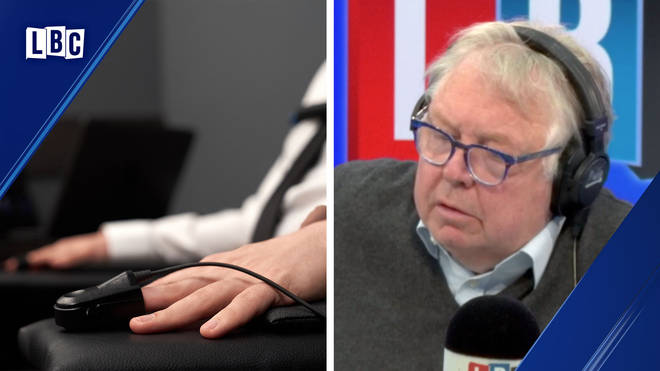 He told LBC: "I trained with the British Army and went through numerous programmes for training and one of them was anti-interrogation. "I'm not saying that every single person could pass a lie detector test, but the actual theory of passing it is pretty simple. "We went through a course on how to regulate your breathing, how to think about the correct answer but answer with the wrong answer. "And for someone to say that a person has passed a lie detector test and he's completely reformed, it is crazy to me." Craig explained that it look just one day of training to be in a position to fool the machine. He revealed: "You can at least give it an unreadable result. Anyone who has a minimal amount of intelligence would be able to do it within a 24-hour period."  |
| Polygraph’s revival may be about truth rather than lies - The Guardian Posted: 21 Jan 2020 12:00 AM PST  Telling lies is stressful. That's the basic logic of a polygraph test: that the stress of deceiving others will manifest itself through fleeting physical responses that may be imperceptible to another person but can be measured by a machine. Typically, a polygraph records blood pressure, galvanic skin response (a proxy for sweat), breathing and pulse rate. There is a fairly standard protocol for the lie detector examination. The examiner will mix specific questions relevant to a case – "Did you commit a robbery on 29 March?" – with a series of control questions. Crucially, the control questions are also designed to be anxiety-inducing – for instance: "Have you ever stolen from a friend?" Along the way, the subject will be reminded that the machine can distinguish truth from lies and that they must respond truthfully. In theory the control questions, designed to be difficult to answer with absolute honesty, will generate some baseline level of stress. For an innocent subject, the assumption is that these questions will be more stressful than the relevant ones, where a straightforward denial can be given. For a guilty party, the relevant questions are expected to be more stressful to answer. So a liar is expected to have higher physiological responses to relevant questions than to control questions, and someone telling the truth will show the reverse pattern. A similar response to each set is judged inconclusive. Many experts question whether this works with any reliability in practice. "Polygraphs work very well as physiological measures – scientific measures of changes in your body as you experience different emotions," said Prof Sophie Scott, a neuroscientist at University College London. "However, they are not scientifically validated as reliable measures that someone is lying. "Indeed, there are no reliable measures of lying, full stop, which is why the police use cognitive measures such as asking people to describe events backwards, to spot inconsistencies as liars start to get things wrong." Prof Chris Chambers, a psychologist at Cardiff University, put it more bluntly: "Polygraphs are bullshit. They have always been bullshit and they will always be bullshit." An exhaustive review of the scientific evidence by the US National Research Council in 2003 indicated that although the polygraph performs above chance, studies had found wildly differing accuracy rates. Some gave accuracies of 85% when evaluating genuinely guilty people, which proponents of the polygraph say underlines its utility. However, the review also highlighted the potential for high false positive rates ( some studies found almost half of innocent people were identified as liars), and it pointed out that people can train themselves to beat a polygraph. It concluded that the US government should not rely on polygraph examinations for screening prospective employees or to identify spies or other national security risks, because the test results were simply too inaccurate. Another analysis published last year reached broadly the same conclusions. Prof Albert Vrij, a psychologist at the University of Portsmouth whose research focuses on deception and lie detection, said overconfidence of examiners in the accuracy of lie detectors was a common theme. "Although they often acknowledge that the test is not always accurate, they often seem to think that other examiners make incorrect judgments rather than they themselves. You never hear stories from polygraph examiners where they got it wrong." Despite their notable shortcomings, lie detectors have had something of a renaissance in the UK in the past decade. Last year the Ministry of Justice launched a three-year pilot of mandatory polygraph tests on convicted domestic abuse offenders released on licence. Tests have also been given to serious sex offenders on parole in England and Wales since 2007, and since 2014 mandatory tests have been added to some offenders' release conditions. Vrij said the reliability of lie detectors in these latest applications was even more unclear. Polygraphs were designed to test someone's involvement in a known crime that occurred in the past. In some cases, sex offender testing could involve open questions about future intentions. "To use sex offender testing as a justification to use it in terrorist cases is odd," said Vrij. "Of course, it gets further away from its original design as the 'crime in question' is no longer a crime committed in the past. To simply introduce the test in an entirely different setting is too far stretched." So the science is shaky. But in the real world, the question of whether lie-detector tests work has another component: irrespective of their accuracy, do they make people tell the truth? There is evidence to support this, including a 2007 study by scientists at the University of Kent which showed that sex offenders who were attached to a fake polygraph admitted to far more thoughts that would place them at risk of future offending than in a standard interview. Perhaps these observations, rather than a disregard for scientific evidence, are the basis of the latest polygraph rollout. Prof Thomas Ormerod, a polygraph expert at the University of Sussex, said: "The use of lie detector tests in this context will, at best, be a waste of police resources, and at worst will exacerbate problems associated with terrorism. Their use will give the public false confidence that they are being protected, while for terrorists who take and pass the tests, it gives them a free pass out of the legal system and cover to carry out attacks unimpeded. Moreover, for genuinely reformed offenders or innocent people implicated in terrorist activity, use of a technique that cannot be used in UK courts as admissible evidence will likely appear discriminatory." "It seems a missed opportunity that the UK government is failing to use the research results it has contributed to funding, preferring instead to rely on techniques that seem to offer a magic technology but in fact are deeply flawed and potentially dangerous."  |
| You are subscribed to email updates from "how to beat a lie detector test" - Google News. To stop receiving these emails, you may unsubscribe now. | Email delivery powered by Google |
| Google, 1600 Amphitheatre Parkway, Mountain View, CA 94043, United States | |


Comments
Post a Comment