polygraph definition
polygraph definition |
- Researchers Built an ‘Online Lie Detector.’ Honestly, That Could Be a Problem - WIRED
- Global Flexographic Printing Machine Market 2019 : Eidos SPA, A. Carnevalli & Cia. Ltda., Class-Engineering and Polygraph - Market Biz Group
- Michael Cohen and the Creation of a Deep Learning AI Lie Detector - TechNewsWorld
- State TV Conflates Leviathan Actor's Anti-war Stance With 'Anti-Russian' Sentiment - Polygraph.info
- Deputy Sheriff Job - Collin County Human Resources - McKinney, Texas - Police News
| Researchers Built an ‘Online Lie Detector.’ Honestly, That Could Be a Problem - WIRED Posted: 21 Mar 2019 04:00 AM PDT  The internet is full of lies. That maxim has become an operating assumption for any remotely skeptical person interacting anywhere online, from Facebook and Twitter to phishing-plagued inboxes to spammy comment sections to online dating and disinformation-plagued media. Now one group of researchers has suggested the first hint of a solution: They claim to have built a prototype for an "online polygraph" that uses machine learning to detect deception from text alone. But what they've actually demonstrated, according to a few machine learning academics, is the inherent danger of overblown machine learning claims. In last month's issue of the journal Computers in Human Behavior, Florida State University and Stanford researchers proposed a system that uses automated algorithms to separate truths and lies, what they refer to as the first step toward "an online polygraph system—or a prototype detection system for computer-mediated deception when face-to-face interaction is not available." They say that in a series of experiments, they were able to train a machine learning model to separate liars and truth-tellers by watching a one-on-one conversation between two people typing online, while using only the content and speed of their typing—and none of the other physical clues that polygraph machines claim can sort lies from truth. "We used a statistical modeling and machine learning approach to parse out the cues of conversations, and based on those cues we made different analyses" of whether participants were lying, says Shuyuan Ho, a professor at FSU's School of Information. "The results were amazingly promising, and that's the foundation of the online polygraph." But when WIRED showed the study to a few academics and machine learning experts, they responded with deep skepticism. Not only does the study not necessarily serve as the basis of any kind of reliable truth-telling algorithm, it makes potentially dangerous claims: A text-based "online polygraph" that's faulty, they warn, could have far worse social and ethical implications if adopted than leaving those determinations up to human judgment. "It's an eye-catching result. But when we're dealing with humans, we have to be extra careful, especially when the implications of whether someone's lying could lead to conviction, censorship, the loss of a job," says Jevin West, a professor at the Information School at the University of Washington and a noted critic of machine learning hype. "When people think the technology has these abilities, the implications are bigger than a study." Real or SpielThe Stanford/FSU study had 40 participants repeatedly play a game that the researchers called "Real or Spiel" via Google Hangouts. In the game, pairs of those individuals, with their real identities hidden, would answer questions from the other in a kind of roleplaying game. A participant would be told at the start of each game whether they were a "sinner" who lied in response to every question, or a "saint" who always told the truth. The researchers then took the resulting textual data, including the exact timing of each response, and used a portion of it as the training data for a machine learning model designed to sort sinners from saints, while using the rest of their data to test that model. They found that by tuning their machine learning model, they could identify deceivers with as much as 82.5 percent accuracy. Humans who looked at the data, by contrast, barely performed better than guessing, according to Ho. The algorithm could spot liars based on cues like faster answers than truth-tellers, a greater display of "negative emotions," more signs of "anxiety" in their communications, a greater volume of words, and expressions of certainty like "always" and "never." Truth-tellers, by contrast, used more words of causal explanation like "because," as well as words of uncertainty, like "perhaps" and "guess."
Kate Crawford, AI Now Institute The algorithm's resulting ability to outperform humans' innate lie detector might seem like a remarkable result. But the study's critics point out that it was achieved in a highly controlled, narrowly defined game—not the freewheeling world of practiced, motivated, less consistent, unpredictable liars in real world scenarios. "This is a bad study," says Cathy O'Neill, a data science consultant and author of the 2016 book Weapons of Math Destruction. "Telling people to lie in a study is a very different setup from having someone lie about something they've been lying about for months or years. Even if they can determine who's lying in a study, that has no bearing on whether they'd be able to determine if someone was a more studied liar." She compares the setup to telling people to be left-handed for the purposes of a study—their signatures would be very different from real-world left-handed people. "Most people can get pretty good at a lie if they care enough," O'Neill says. "The point is, the lab [scenario] is utterly artificial." FSU professor Ho counters critics that the study is merely a first step toward text-based lie detection, and that further studies would be needed before it could be applied. She points to caveats in the paper that clearly acknowledge the narrow context of its experiments. But even the claim that this could create a path toward a reliable online polygraph makes experts anxious. Frowning Criminals, Performing LiarsTwo different critics pointed to an analogous study they say captures the fallacy of making broad claims about machine learning's abilities based on a narrow test scenario. Chinese researchers in 2016 announced that they'd created a machine learning model that could detect criminality based merely on looking at someone's face. But that study was based on photos of convicted criminals that had been used as identification by police, while the non-convict photos in the same study were more likely to have been chosen by the person themselves or by their employer. The simple difference: The convicts were much less likely to be smiling. "They'd created a smile detector," the University of Washington's West says. In the lie detection study, there's almost certainly a similarly artificial difference in the study's groups that doesn't apply in the real world, says Kate Crawford, the co-founder of the AI Now Institute at New York University. Just as the criminality study was actually detecting smiles, the lie detection study is likely carrying out "performance detection," Crawford argues. "You're looking at linguistic patterns of people playing a game, and that's very different from the way people really speak in daily life," she says. In her interview with WIRED, FSU's Ho did acknowledge the artifice of the study. But in the same conversation, she also suggested that it could serve as a prototype for an online lie detector system that could be used in applications like online dating platforms, as an element in an intelligence agency polygraph test, or even by banks who are trying to assess the honesty of a person communicating with an automated chatbot. "If a bank implements it, they can very quickly know more about the person they're doing business with," she said. Crawford sees those suggestions as, at best, a continuation of an already problematic history of polygraph tests, which have been shown for years to have scientifically dubious results that are prone to both false positives and being gamed by trained test takers. Now, the FSU and Stanford researchers are reviving that faulty technology, but with even fewer data sources than a traditional polygraph test. "Sure, banks might want a really cheap way to make decision to give loans to or not," Crawford says. "But do we want to be invoking this kind of problematic history based on experiments that are themselves questionable in terms of their methodology?" The researchers may argue that their test is only a reference point, or that they're not recommending it be used for real-world decisions. But Crawford says they nonetheless don't seem to be truly weighing how a faulty lie detector could be applied—and its consequences. "They're not thinking through the full social implications," she says. "Realistically they need a lot more attention to the negative externalities of a tool like this." More Great WIRED Stories |
| Posted: 25 Mar 2019 03:35 AM PDT The research report "Flexographic Printing Machine Market: Global and Regional Industry Analysis 2019 – 2024" discover accurate information about the long run prospects of this flexographic printing machine market, which can help industry players to understand the flow of the market throughout the period 2018-2023. The global flexographic printing machine market has defined the market scenario in an orderly way, emphasizing the industrial development, prominent players engaged from the current flexographic printing machine market, chapter wise market specifications, industrial procedures, that will absolutely assist our readers to aim towards the flexographic printing machine industry perspective and promote stability with cost-effectiveness and revenue structure. The primary objective of this report will be to send its readers with a real intelligence on the Global Flexographic Printing Machine Market, to aid them in collecting and slating possible strategies by holistic insights provided on flexographic printing machine market. The report begins with the market introduction which is accompanied closely by statistical particulars of this market that reveals the flexographic printing machine market current status and future prediction and classification such as product types, and flexographic printing machine end-use applications, as well as region. These further shed light on market factors like market developments, flexographic printing machine demand and supply, current market scenario and it's growth trajectory in decades, opportunities for stakeholders in worldwide flexographic printing machine market. Also, the report discusses business plans, sales and profit, market stations and market volume, flexographic printing machine raw material suppliers, and buyers demand information and distribution ratio. Competitive landscape segment in the flexographic printing machine report relies on the current as well as the potential of the leading market players at the market. It offers the in-depth company profiles of a number of the significant market players, that may stay active in pre-destined decades, combined with company profile, flexographic printing machine product launches, product market, and gross margin, financial details, key advancements, flexographic printing machine business short-term and long-term marketing and advertising strategies and SWOT analysis of these competitive firms. Get Sample PDF of Report with Your Corporate E-mail ID@ https://market.biz/report/global-flexographic-printing-machine-market-2018-mr/313179/#requestforsample The key players mentioned in the global flexographic printing machine market: Polygraph, Eidos S.P.A., Esko-Graphics, Uteco Converting SpA, Amaco Ing. Vonach Gmbh, Dcm Usimeca, A. Carnevalli & Cia. Ltda. and Class-Engineering Global Flexographic Printing Machine Market: Segmentation OutlookThe report provides global flexographic printing machine market segmentation based on the product type, end-users, and region. The report offers an analysis of individual market segments from 2013 to 2018 and forecast from 2019 to 2024. The flexographic printing machine market shares of each segment are calculated in the form of revenue likely to be generated (USD million) and year to year growth rate (CAGR). In the additional section, flexographic printing machine report includes market division study over the significant geographies of the world such as North America, Asia-Pacific, Europe, South America, The Middle East & Africa and rest of the world. Product Types: Multi-Color and Monochrome End-Use Applications: Application 1, Application 5, Application 3, Application 4 and Application 2 Any Query? Ask our Expert @ https://market.biz/report/global-flexographic-printing-machine-market-2018-mr/313179/#inquiry Imperative Points Covered in the Global Flexographic Printing Machine Market
Get more details about Global Flexographic Printing Machine Market, Visit Here: http://reporte.us/global-flexographic-printing-machine-market/   |
| Michael Cohen and the Creation of a Deep Learning AI Lie Detector - TechNewsWorld Posted: 04 Mar 2019 12:00 AM PST Like many of you I was fascinated by the Michael Cohen testimony last week in what was more performance art than fact-finding. It tends to be fascinating to watch disgruntled ex-employees testify, but they often aren't the most reliable witnesses. The personal nature of their termination tends to push them toward exaggeration, and many were fired for legitimate reasons. However, I'm a tech analyst, and I'm always thinking about how I would make something better. In this case, there were several ways you could define "better" -- more helpful to my own political party, more entertaining (thus holding more viewers), or more likely to drive real change. I'm about real change, and what would have been helpful to most of us would have been something that told us, with acceptable confidence, two things. The first is obvious: whether he was lying. The second isn't as clear: whether what he said was true. That may seem like a weird distinction, but I'll explain how deep learning artificial intelligence could perform both tasks with acceptable levels of confidence. I'll close with my product of the week, HoloLens 2 from Microsoft -- an offering that is taking us closer to true magic. What Is Truth?We often focus on the wrong thing. In the movie Minority Report, the fictional tool that was used to predict crime used people with precognitive capability to identify a likely crime so the future criminal could be incarcerated without damage being done. The focus was on incarceration rather than preventing the crime, and that is why the service failed. Had it instead focused on warning both the victim and the future criminal, the problem with it being less than 100 percent accurate would have been mitigated. The actual goal, preventing the crime, would have been more sustainable. I put this in the context of Cohen's testimony, because the supposed goal is to get the truth. Yet if you watched the hearing, you saw that Republicans were far more focused on discrediting Cohen (and they didn't defend Trump at all -- seeming to suggest Trump may not be defensible). You would think that in most cases the truth and lying would be aligned, but often they aren't. Many make compellingly arguments that are wrong, but they aren't lying. Their beliefs are out of line with reality. I'd argue that, generally, knowing if what is being said is true is more important than knowing whether the speaker is lying. A charismatic believer who is also unhinged with respect to the truth can be far more dangerous than a simple liar. I use Minority Report as an example because one of the powers of a deep learning AI is that it has the potential to be highly predictive -- with increasing accuracy based on timing and the quality and amount of information. If you have a system that could predict the future with high accuracy, you also have enough information to make the two important determinations I mentioned: whether what is being said is true; and whether the speaker is lying. In theory, we should care about the truth more, but during the Michael Cohen testimony the Democrats focused on making the anti-Trump testimony more powerful, and the Republicans focused on arguing Cohen was a liar. Neither side really spent that much time validating the testimony, even though Cohen did supply corroborating documents. This isn't uncommon at all. In a trial, the experts on your side are believed absolutely while the experts on the other side are believed to be dishonest crooks. The poor judge -- at one time I wanted to be one -- who generally isn't a subject matter expert, then must figure out which expert to believe. Qualcomm vs. FTCI attended parts of the Qualcomm FTC trial, and it was clear the FTC expert was unreliable. He was one of those folks who takes a position, then does the work to validate it, and then uses the defense that he is the smartest person in the room and everyone who disagrees with his position is an idiot. That kind of expert is dangerous. You should start with the evidence and then form your position, not the other way around, or confirmation bias is likely to cause you to reach the wrong conclusion. The FTC expert testified for the DoJ in a prior trial involving a different case -- AT&T's Time Warner Merger I believe -- and the judge tore into him with a passion, basically saying his "theory" was crap. This questionable expert was the FTC's pivotal witness. A strong argument can be made that the FTC wasted a massive amount of money, as did Qualcomm, presenting and then defending against an invalid theory. Had the FTC known that the expert's theory had been discredited, it may have avoided both a likely loss in court and the unnecessary expenditure of resources to prosecute a nonexistent crime. Deep Learning AI FixDeep learning AIs are new. What makes them so incredibly powerful compared to their earlier machine learning counterparts is that they train themselves at computer speeds. Machine learning required humans to teach the machines, but deep learning systems, for the most part, learn independently. Given the right framework, they will churn through massive amounts of information to become ever more capable of making autonomous decisions. This means they could look at a case like Qualcomm's, for instance, and determine not only if a crime was committed, but also whether it would be worthwhile to prosecute it. For instance, let's say someone grabs a small child out of traffic, and the police want to know whether the child is safe at home. There might be a case for child endangerment, but if the situation were something like the mother dropping some groceries and the child using the distraction to make a mistake, that would be viewed far differently than if the mother had an attention deficit problem that resulted in the child not being supervised adequately. The AI would look at the pool of available information on both the child and the parent and, within seconds, provide high quality advice on whether the child should be returned to the parent with a light warning or put into some protective service. The main goal would remain pristine as well -- in this case to protect the child, not to punish the parent. Even if the recommendation were to act against the parent, the deep learning AI could determine, based on what was known about the parent's personality and history, what remedy would fix the problem. It could be removing the child from the parent's care -- or it could be getting the parent help to better focus on the child's well being. Michael Cohen's TestimonyWith respect to Michael Cohen's testimony, neither side optimized the opportunity presented, because of the lack of focus on truth. The Republicans likely are the most at risk, though, because Cohen did have supporting documents, suggesting what he was saying largely was true. (There were some huge holes, particularly regarding his working at the White House, but in general he was well supported.) So, if the president is impeached, which seems increasingly likely, videos of legislators pounding on Cohen probably will hurt their re-election chances severely. On the other hand, the Democrats should have played off each other more and built a case for impeachment. (It's ironic that the youngest committee member was the only one to seem to get that memo.) Their goal is to impeach, but they still need to build a compelling, simple case. Now introduce an AI that could report which parts of Cohen's testimony were backed up -- both by the facts he brought and third-party testimony -- and the parts that weren't. The Republicans then would focus on tearing into the unsupported elements of the testimony, and the Democrats could avoid them. Both efforts would be more likely to succeed (and look good during subsequent election efforts, regardless of what happened to Trump. Underneath, both efforts would be focused more tightly on the truth. The result should be more truthful testimony overall, because it quickly would become clear that false testimony, at best, would be a waste of time -- and at worst, result in criminal charges and jail time. In short, there would be an increasing realization that lying would have no upside. The U.S. just went from a president (Obama) who clearly had issues with the truth, to one who probably can't spell the word. I don't think that is a good trend at all, and I don't think this will end well for Trump or the country -- but that ending is still avoidable. I think we all would appreciate a little more truth from our leaders. More importantly, we at least want them to know what the truth is. Otherwise, the decisions they make likely will drift toward catastrophically bad way too often. They, and we, need a reliably accurate detector of the truth. We also need to know which of our leaders simply are unable to see the truth, regardless of who presents it. Wrapping Up: Deep Learning Lie DetectorI think we are on the cusp of creating a deep learning lie detector -- a tool that in real time could, with increasing accuracy, tell us not only whether the person speaking is lying but also whether the person was conveying real facts vs. unsupported beliefs or delusions. This last part is important, because we have climate change deniers and vaccination unbelievers who are on a path to making humans extinct. Some of these folks are in positions of power, or will be. With this technology we could make fake news obsolete, eventually. That alone would be a good thing. As a side note, how many of you want to see President Trump's school grades now? |
| Posted: 28 Feb 2019 12:00 AM PST On Monday, February 25, 2019, Russian state media outlet RIA Novosti took aim at popular actor Aleksey Serebryakov over comments critical of Moscow's foreign policy. During a forum in London, Serebryakov said that Moscow had "incited conflicts" in Georgia, Chechnya, Syria, Africa and Ukraine, while also accusing the government of "rewriting history."  The RIA report specifically took issue with the inclusion of Africa, noting the artist had not "clarified" what the Russian incitement would be "guilty" in Africa. Serebryakov could well have been referring to reports that Russian private military contractors with state support are operating in the Central African Republic and beyond. "This is not the first time Serebryakov has delivered anti-Russian statements," RIA reported, noting a February 20, 2018 interview in which the actor said Russia's national identity was defined by "power, arrogance and rudeness." "No matter how you look at it, today neither knowledge, enterprise, intelligence nor dignity are part of our national idea. Our national idea is power, arrogance and rudeness," Serebryakov said. Creating a "Russian national idea" has been a key part of Putin's presidential agenda since his coming to power nearly two decades ago. "Patriotism is the Russians' holy duty. That is our national idea," Putin said in his speech before the students of the Moscow State University in 2016. The Russian Orthodox Church joined the Putin narrative, announcing that the national idea of Russia is to "be holy." Serebryakov's opinion is clearly different. But RIA's characterization of Serebryakov's statements as "anti-Russian" are misleading. To disagree with and criticize the current government for historical revisionism and to state it has incited conflicts at home and abroad, correct or not, is clearly an opinion regarding policy and not nationality. Serebryakov said as much in comments to RIA Novosti, stating he is "a patriot of Russia, no less than those who shout about it."  "Since I am a citizen of Russia, I have a civil position which is connected with the fact that war is a terrible tragedy comparable with planetary cataclysms," he said, adding that life is priceless and he is an "active pacifist against war." Even his previous comments can be interpreted as much as his Hobbesian view on life in the Russian provinces (a prominent feature of one critically-acclaimed film in which he starred, Leviathan) as anti-Russian sentiment. Serebryakov, who immigrated to Canada with his family in 2012, faced a harsh backlash at that time, with Leviathan producer Alexander Rodnyansky claiming the public outrage only served to prove the actor's point. "Unfortunately, here in Russia we are familiar with such attacks," Rodnyansky told The Hollywood Reporter. "Serebryakov's opinion can be irritating to someone and people have the right to disagree with him, but the harassment that ensued, calls to strip him of his Russian passport and ban him from ever working again — this just proves his point, that the Russian society is ill," he said. Writing for Vedomosti, Pavel Artekar said "maybe the actor's words were a little clumsy," noting that '"power, arrogance and rudeness' cannot be said to define the national identity." "The description better fits the behavior of Russia's bureaucrats — at home and abroad — in recent years," Artekar said. Leviathan itself was similarly lambasted at home for being anti-Russian, with Orthodox Christian activist Kirill Frolov calling it "a filthy libel against the Russian church and the Russian state" and Culture Minister Vladimir Medinsky attacking it for alleged inauthenticity.  "However much the authors made them swear and swig liters of vodka, that doesn't make them real Russians. I did not recognize myself, my colleagues, acquaintances or even acquaintances of acquaintances in 'Leviathan's' characters," the New York Times cites Medinsky as telling the newspaper Izvestia. "Strange, but among the movie's characters there is not a single positive one." Other popular artists in Russia have similarly faced accusations of anti-Russian sentiment when criticizing government policy. Rock star Andrei Makarevich was attacked for his decision to perform in Eastern Ukraine territory under Ukrainian government control, with Yevgeny Fedorov, an MP for the ruling United Russia party, saying he should be stripped of his state awards. In 2014, following Russia's military incursion into Ukraine, Makarevich found himself alongside fellow rock star Yuri Shevchuk and three political figures – Ilya Ponomarev, Aleksei Navalny and Boris Nemtsov – on a banner hung from House of books reading "Fifth column. Foreigners among us." 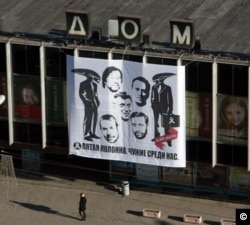 Of those five men, Navalny has been regularly attacked and blinded in an acid attack, Ponomarev was forced into exile and Nemtsov was murdered outside the Kremlin four years ago on February 27, 2015. All four have been detained and arrested on multiple occasions for organizing or taking part in opposition marches. Russian actress Liya Akhedzhakova, a critic of the Kremlin's policy, last month said that young people are now afraid to express their civic position." She added. "Today there is a lot of Sovietism. There's snitching. There's denunciations … it's generally a tradition in Russia. To knock, to pawn people." She brought up the case of Alexander Sokurov, a renowned director who correctly predicted his Example of Intonation foundation would be targeted due to his criticism of Putin and the Russian government. Meanwhile, while Russian singer Yuri Loza said Serebryakov should no longer be offered roles and producer Joseph Prigozhin said some people's minds "are simply missing" in relation to the controversy, actor Alexei Panin said Serebryakov is understood by every reasonable person and "everything he said was correct." As to Serebryakov's claims about Russian involvement in Africa, there is plenty of evidence Russia focuses on propping up fragile nations battling civil war, such as the Central Africa Republic. "The current Kremlin is trying to export counterrevolution," Kiril Avramov told the Voice of America Russian Service. The post-doctoral research fellow at the University of Texas at Austin's Intelligence Studies Project said than destabilizing regimes, Russia looks for countries already besieged. Last year, Russia proposed a logistic base in Eritrea, an East African country emerging from decades of conflict with a neighbor.  |
| Deputy Sheriff Job - Collin County Human Resources - McKinney, Texas - Police News Posted: 22 Mar 2019 12:12 PM PDT Applicants for the Deputy Sheriff position will proceed through a series of tests based on passing scores and rankings. Here is a list of what can be expected: Civil Service Written Examination Personal History Statement Physical Fitness Test Polygraph Test Psychological Test Oral Board Review Pre-Employment Physical You will be contacted with additional information on how to proceed through the testing process once your application is complete and you are found eligible for the position. LATERAL HIRE EXEMPTION Applicants who meet a certain, higher level of experience and licensing may qualify for consideration as a "Lateral Hire." A Lateral Hire candidate is exempt from some, but not all, pre-employment processes as defined in the Collin County Sheriff's Office Civil Service Rules document. The section pertaining to Deputy Sheriff Lateral Hire qualifications and exemption is below: Qualifications for Lateral Hire: A person who (1) has five cumulative years of full-time law-enforcement experience as a peace officer, including experience in an agency outside of the state, (2) has a current Texas peace officer's license, and (3) is currently employed by a Texas law-enforcement agency and is in good standing, including with respect to psychological and physical fitness and weapons proficiency, is eligible for the following lateral-hire exemptions. Lateral-Hire Exemptions: A person, who qualifies for lateral hire, is exempt from this section's requirements or provisions: (1) to undergo a psychological examination, if the person submits proof they have completed a psychological examination within the last five years that is valid with TCOLE, (2) to undergo a polygraph examination, and (3) to pass a physical-agility test. Lateral-hire candidates must complete and return a Personal History Statement to the Sheriff's Office no later than 21 calendar days after receiving the Statement. Collin County offers a fast-paced working environment, tuition reimbursement, and a comprehensive benefits package including medical, dental, vision, life insurance, and long and short term disability. Retirement benefits have an excellent employer match. You must submit a completed application to be considered for employment. Attaching a resume is not considered an acceptable substitute for a completed application. COLLIN COUNTY IS AN EQUAL OPPORTUNITY EMPLOYER  |



 Rob Enderle has been an ECT News Network columnist since 2003. His areas of interest include AI, autonomous driving, drones, personal technology, emerging technology, regulation, litigation, M&E, and technology in politics. He has an MBA in human resources, marketing and computer science. He is also a certified management accountant. Enderle currently is president and principal analyst of the
| You are subscribed to email updates from "polygraph definition" - Google News. To stop receiving these emails, you may unsubscribe now. | Email delivery powered by Google |
| Google, 1600 Amphitheatre Parkway, Mountain View, CA 94043, United States | |


Comments
Post a Comment