polygraph definition
polygraph definition |
- Police Recruit Job - Las Vegas Metropolitan Police Department - Las Vegas, Nevada - Police News
- Police Officer Candidate (Certified and Non-Certified) Job - CITY OF BOCA RATON - BOCA RATON, Florida - Police News
- Michele Neurauter murder: "I had to choose": Did a father brainwash his daughter to help kill her mother? - CBS News
- Inside the Black Mirror World of Polygraph Job Screenings - WIRED
- Mike Pence Swears His Loyalty on the Sunday Shows - The Atlantic
| Police Recruit Job - Las Vegas Metropolitan Police Department - Las Vegas, Nevada - Police News Posted: 20 Mar 2019 08:10 AM PDT Conditions of Employment, the following specific conditions of employment and physical conditions apply to this position: 1.Wear a uniform and maintain a neat and clean appearance. 2.Study the learning materials on off-duty time. 3.Obey the laws of the State of Nevada, City of Las Vegas and the County of Clark. 4.Purchase their own equipment that is required for this position. 5.Wear a body camera and vest, and other safety equipment. 6.Work any hours, days, or shifts, including holidays and weekends. 7.Participate in the Department's random drug screening process. 8.Maintain physical fitness necessary to carry out job duties. 9.Comply with the Department's rules and regulations. 10.Adhere to the Department's values represented by the "ICARE" acronym. 11.Stay current on their training. 12.Obtain/maintain a Nevada driver's license, and register/maintain registration of personal vehicle with the Nevada Department of Motor Vehicles and Public Safety (DMV). 13.Undergo a background investigation, which will include a polygraph, drug test, medical exam, standard hearing test and psychological testing. 14.Accept the requirements of the specific area of assignment. 15.Personal Appearance: While on duty, and/or representing the Department, uniformed or otherwise, all Department employees will be neat and clean in their appearance in public. Employees are prohibited from attaching, affixing, or displaying objects, articles or jewelry on or through the nose, tongue, eyebrow or other exposed body part, except the ears for females, while on duty. Employees are prohibited from stretching or "gauging" their earlobes. All jewelry implants will not be exposed or visible while on duty. Tattoos or branding will not be exposed or visible while on duty and/or representing the Department. Such markings must be covered by clothing, and may not be covered by make-up or bandages. Tattoos or branding anywhere on the body that promote racism/discrimination, indecency, extremist or supremacist philosophies, lawlessness, violence, or contain sexually explicit material are prohibited. 16.Physical Conditions: Essential and marginal functions may require maintaining physical condition necessary for running, climbing, standing, squatting, and sitting for prolonged periods of time; strength to subdue persons, to drag, carry and lift persons and objects; dexterity to write and to shoot a gun; to be heard in noisy group situation.  |
| Posted: 21 Mar 2019 09:17 AM PDT GENERAL DEFINITION OF WORK: Performs difficult professional work to protect and serve the citizens through enforcement of city ordinances and state and federal laws, prevent crimes, apprehend criminals, and provide aid and assistance. Responds to calls for service for emergencies and non-emergencies; Prepares reports, affidavits, and other documentation as required; Conducts investigations of calls for service and crime scenes; Arrests and processes persons committing felonies/misdemeanors and city code violations; Patrols business and residential areas, and works with CRIME WATCH coordinator; Enforces laws, investigates accidents and directs traffic. Testifies at depositions and in court; Performs first aid and CPR. Work is performed under regular supervision. Performs related tasks as required. KNOWLEDGE, SKILLS AND ABILITIES: Thorough knowledge of federal and state law and municipal ordinances; Police Department policies and procedures; and geography and demography of jurisdiction and related crime situation. Proficient in use of police equipment. Must be able to read, write and speak clearly in English language. Must have mental capacity and ability to make deadly force decisions. Must be available to be on call 24 hours a day. PHYSICAL DEMANDS: Must be able to wear hard hat/helmet, safety glasses, goggles, bullet-proof vest, hearing protectors, face shield, and gloves. Exposure to extreme temperatures, animals/insects, confined spaces, heights, noise, dust, vapors, fumes, mist, smoke, toxic metals, poisons, irritants, and blood borne pathogens. EDUCATION AND EXPERIENCE: •Must be at least 19 years of age. •Must have at least one of the following:
•Must have no convictions of a felony or misdemeanor involving moral turpitude.  |
| Posted: 23 Mar 2019 08:20 PM PDT Produced by Christopher Gidez On Aug. 28, 2017, police in upstate Corning, New York, were called to the home of Michele Neurauter. Police found the 46-year-old mother of three hanging from a rope -- an apparent suicide. But Police Chief Jeff Spaulding had doubts, calling a rope mark found on Michele's chin "unsettling." Michele's mother Jeanne Laundy thought she was murdered, and pointed fingers at Neurauter's ex-husband, even though he was more than 2,500 miles away on a job interview in California when Michele was found dead. "I'm thinking it's more than likely Lloyd killed her," Jeanne Laundy told "48 Hours" correspondent Erin Moriarty. Lloyd Neurauter was Michele's ex-husband. For five years, the couple had been embroiled in bitter custody battles. Michele accused Lloyd of turning their daughters against her. On the day police found Michele, the couple's 19-year-old middle daughter, Karrie, at college in Rochester, told investigators that over the weekend, her father helped her move into her college apartment and that he had spent all night at a hotel. But when police checked the hotel video, they actually see Lloyd getting into Karrie's car with Karrie -- who had visited him at the hotel. In the video, Lloyd doesn't return until the next morning. Police soon began listening in on phone calls between father and daughter -- and that's when the investigation turned in a way no one saw coming. "We just don't have cases like this, where this level of pervasive evil trickles through an entire life and then ends in such a horrific event," said Steuben County, N.Y. District Attorney Brooks Baker. A BROKEN FAMILYOn a cold January day in 2018, 45-year-old Lloyd Neurauter was surrounded by local and state police five months after Michele's death.
D.A. Brooks Baker | Steuben County, N.Y.: He's on a ledge on the fifth story of a parking garage in Princeton, New Jersey, threatening to jump. It wasn't supposed to end this way. Almost 30 years earlier in 1989, 16-year-old Lloyd had fallen for an older classmate, Michele Laundy. Jeanne Laundy: They were going to the same high school. And she was graduating, and we told her she could invite friends, and … she invited Lloyd. Michele's mother Jeanne Laundy remembers how quickly the relationship developed. Erin Moriarty: How did she feel about him? Jeanne Laundy: Oh, she was falling in love. Two years later, in 1991, Michele and Lloyd tied the knot. The newlyweds headed off to college. Michele gave birth to a daughter, and two years later, a second child, Karrie. 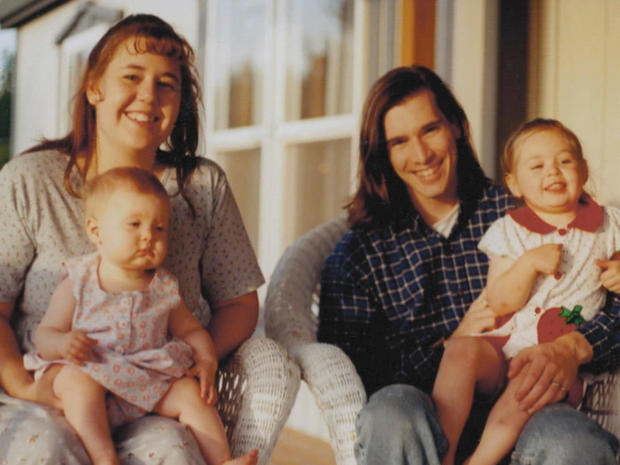 The family settled in the upstate New York community of Corning. D.A. Brooks Baker: It's the kind of place where a lot of folks still don't lock their doors. Corning is a quaint, family place best known as the headquarters of Fortune 500 company Corning Glass. Lloyd worked there as an engineer. Michele gave birth to a third daughter and she homeschooled the kids. Later she would teach at a local college. Mina Raj: She was an English professor when I met her, so she was big on reading and writing … and … she would always really encourage her girls to be well spoken and educated. Mina Raj met the Neurauter's middle daughter Karrie in ballet class. The two quickly bonded. Mina Raj: All of our dance families were very close. Her mother Cynthia would become one of Michele's closest friends Erin Moriarty: When's the very first time you met Michele? Cynthia Raj: I met Lloyd first, because he would bring the children to class, dance classes … he would do their hair … and the mothers were rather smitten with him. Mina Raj: I thought he was a really amazing person. He's very charismatic, shows a lot of care. But as Mina spent more time with Karrie, she became concerned about Lloyd's overbearing parenting style. Mina Raj: There were times when I'd call my mom and tell her that I was worried about how strict of a disciplinarian he was, for really, really small things. It was sort of like you never knew when he would snap. … and if he decided he was mad at one of them, he would call them over, yell "front and center." …have them drop to their knees in front of everyone. Cynthia Raj: The first time I witnessed that … Karrie was very close to me, and I could see, physically see her body shaking Mina Raj: I've seen him slap them. Erin Moriarty: Slap? Across the face? Mina Raj: On the face, yes. Erin Moriarty: Would he do things to Michele? Jeanne Laundy: He would put her down … with a smile on his face. And then around Thanksgiving 2007, Michele suddenly cut ties with her parents. Her mother believed Lloyd was behind the rift. Erin Moriarty: What do you think happened? Jeanne Laundy: I think that he threatened her, either to harm the children … or to harm her. Cynthia Raj: She said, "Cynthia … It was Lloyd that made me cut off contact with them." He didn't want her to have a place to go if she wanted to leave. But it turned out to be Lloyd who left the following year. In 2008, he took a new job in New Jersey, leaving Michele and the kids behind in Corning. Cynthia Raj: Once he was gone Michele seemed like a different person. Erin Moriarty: Better? Cynthia Raj: Better, she seemed much more relaxed. Susan Betzjitomir was Michele's attorney. Susan Betzjitomir: Her husband had filed for divorce. Michele was surprised that he filed for divorce, she was a stay at home mom, she had done everything she thought she could do to make him and the family happy. And in 2013, after the couple had divorced, Michele moved into a new house with the girls. And that's when the real trouble began. Lloyd wanted sole custody of the kids. Susan Betzjitomir: Lloyd was relentless in using the legal system to harass Michele. … It just never ended. Susan Betzjitomir: There were 26 separate sets of filings post-divorce. Erin Moriarty: And how unusual is that? Susan Betzjitomir: That is super unusual. If you have two or three, it's a lot. To have 26 is astounding. Erin Moriarty: And what was he suing for? What were these filings for? Susan Betzjitomir: He continually filed things making false claims against Michele … Lloyd was trying to get out of child support. And Michele accused Lloyd of trying to turn the kids against her. The oldest daughter was already living with Lloyd and Karrie had gone off to college. Susan Betzjitomir: Karrie was … at RIT, she was set to graduate in another year. But Lloyd continued to fight for custody of their youngest child, then 14 years old. "48 Hours" we agreed not to show recent pictures of her. D.A. Brooks Baker: I think anybody who worked in a courthouse had heard about the Neurauter case, this husband and wife were going at it nonstop. … So, this is one of those cases that everybody sort of heard about, talked about over the water cooler or at a bar and the name came up. It was one of those cases that just didn't go away. But in late August 2017, Lloyd did something unusual. Betzjitomir got a text from Michele: Susan Betzjitomir [reading text to Moriarty]: He says, "I'm in shock, Lloyd did not show up for the appearance for his petition for sole custody … He did not withdraw, he did not ask for an adjournment. He did not answer the courts phone calls, emails, nothing … Erin Moriarty: How unusual is that for him, knowing how many of these filings he's made Susan Betzjitomir: It was very unusual. It was very unusual. It was unthinkable, really. Because of Lloyd's no-show, the case was dismissed. Michele seemed relieved and happy. Susan Betzjitomir: It was summer, and she had a mutual friend of ours and the children sliding on big blocks of ice down a hill of grass. Two days later, on Monday, Aug. 28, 2017, a family friend came to pick up the Neurauter's 14-year-old for swim practice. Instantly, he knew something was very wrong:
Corning Police Sergeant Jon McDivitt was the first to respond to Michele's house that afternoon. Erin Moriarty: Alright. So, tell me what you did. Sgt. Jon McDivitt [outside Michele's house]: So, I walked up to the front door here. And through these three panes of glass I could see inside. … And I could see a female laying at the bottom of the stairs. … Opened the door. A dog came running out. I came running in. … And as I got closer I could see … There was a rope around her neck. … there was no pulse. She was cold and stiff to the touch. 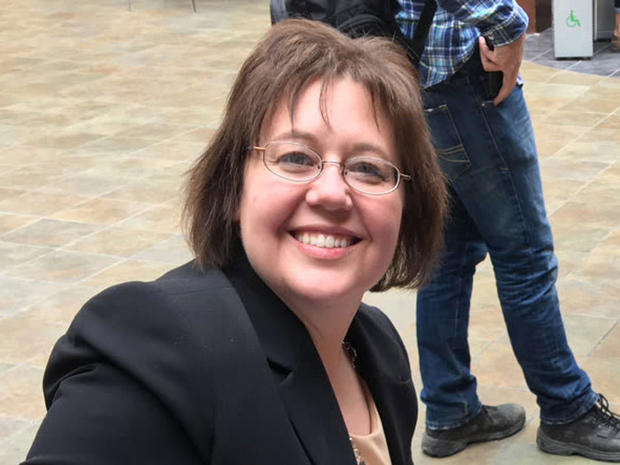 He found 46-year-old Michele Neurauter dead. Erin Moriarty: So, your first thought when you saw her was what? Sgt. Jon McDivitt: It appears to be a suicide by hanging. But, Corning Police Chief Jeff Spaulding wasn't so sure. Erin Moriarty: Because you couldn't figure out how she got a mark here [gestures a U shape around her chin]. Chief Jeff Spaulding: No, I didn't like that, that was unsettling. it appeared as though – somebody … had gone behind and thrown a rope over the neck and pulled back and down and caused that. What's more, Michele's youngest child – the 14-year-old at the heart of the custody battle, and who was supposed to be picked up for swim practice -- was nowhere to be found. D.A. Brooks Baker: Obviously the number of possible outcomes there that are bad is tremendous. A FRANTIC SEARCHLt. Jeff Heverly | Corning Police Dept.: I said … "have we checked, you know, basements? Have we checked attics? Have we checked garages?" In the hours after police arrived at Michele Neurauter's home, a frantic search was on. Lieutenant Jeff Heverly couldn't find her 14-year-old daughter anywhere Lt. Jeff Heverly: She should have been around. I knew that she resided with mom. Later that day, he got a phone call:
It was 19-year-old Karrie Neurauter, Michele's middle child:
Karrie told the officer that her younger sister was safe:
She was nearly 100 miles away with Karrie in Rochester, New York.  Karrie then told Heverly how it happened. She had driven back to Corning late Saturday night to spend one last night in her bedroom at home:
Karrie said her mother raged at her, accusing her of taking her father's side in their family court battles:
Karrie says she decided to leave, taking her younger sister with her. Lt. Jeff Heverly: She claimed that … she was concerned for her younger sister, so she had taken her … outside, put her in the car … and then had driven her to Rochester.  While police were relieved that Michele's youngest was safe, Karrie's story didn't really make sense. Why would Michele be so upset on the same day she had been celebrating her court victory? Those who knew Michele best couldn't believe she'd take her own life. Susan Betzjitomir: I never believed it … She was determined to have a successful life and she did. Cynthia Raj: She had a great job … and it was not the place in her life where she would have committed suicide after all of the really difficult years she had been through. While it appeared Michele had hanged herself, there was that odd ligature mark on her chin. As police awaited the results of the autopsy … Chief Jeff Spaulding: I thought we would get some definite results. They would say, "Yeah 100 percent this is a homicide." Or, "Yeah, 100 percent. This is a suicide." But the Medical Examiner's conclusion surprised them. D.A. Brooks Baker: And they tell us, "Undecided. Undetermined causation." Michele's mother didn't need an autopsy to tell her what happened. Jeanne Laundy: I did not believe she killed herself. 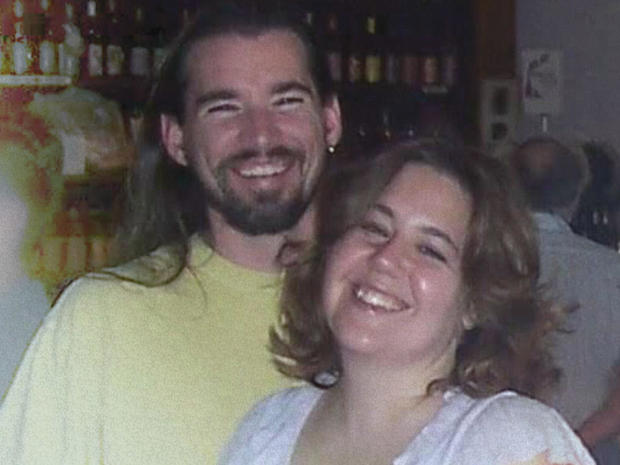 She immediately thought murder -- and one name came to mind. Jeanne Laundy: I'm thinking it's more than likely Lloyd killed her, but I couldn't figure out how because he had an alibi. Lloyd Neurauter was, in fact, more than 2,500 miles away in California for a job interview when police discovered Michele's body:
Karrie told investigators all about it:
Even if Lloyd wasn't in Corning, he'd been close -- about 100 miles away. D.A. Brooks Baker: So, all of a sudden … he's only an hour and change away up in Rochester. Karrie says that after her father helped her move in to her Rochester apartment on Saturday, he spent the night in a hotel and he flew out to California the next day. He was still there when family notified him of Michele's death. He flew back east and, within 36 hours, showed up at the Steuben County Family Court. D.A. Brooks Baker: He came … to turn off his child support and maintenance payments. Erin Moriarty: That's the first place he went when he heard his ex-wife had committed suicide? D.A. Brooks Baker: That's correct. Police caught up with him outside the courthouse:
D.A. Brooks Baker: They sit down in the investigators' car and they do a videotaped interview and have a long conversation. 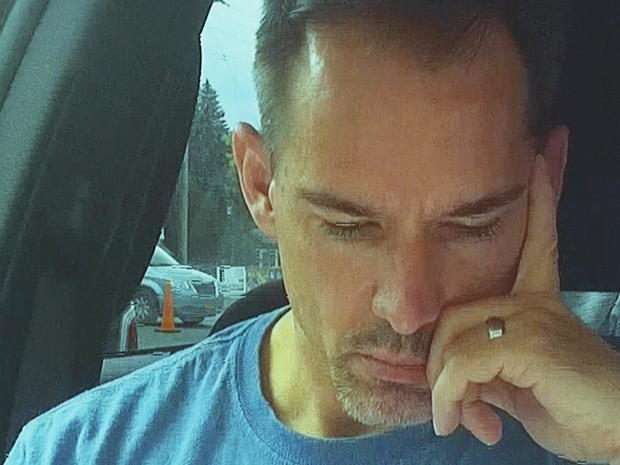
Lloyd calmly echoes Karrie's story. In the hours before Michele's death, he was in Rochester helping Karrie move into her college apartment:
Lloyd says he checked into that hotel Saturday. Hotel security cameras back him up. Karrie came over for a while. Dark parking lot video then shows both he and Karrie heading to her car:
And at 7:00 a.m. the next morning, cameras show Karrie arriving for breakfast, now with her 14-year-old sister in tow. Erin Moriarty: And you also then checked his phone. Where was this phone during that time? Chief Jeff Spaulding: Checked his phone. …it kind of corroborated what Karrie had told us. That dad stayed at the hotel. But the hotel video tells a different story. When Lloyd walked Karrie to her car that night, he can be seen getting in the car with her and then driving off. And the video doesn't show him coming back that night. So, while Lloyd's phone was in the hotel room all night, where was Lloyd? Investigators had to wonder -- especially when they looked at the hotel video from the next morning. Chief Jeff Spaulding: We don't see Lloyd all night long … and here it is 6:30 in the morning … and here he comes onto the camera, he's walking across the parking lot and he's walking to his vehicle. … He still appears to be wearing the same clothes that he had on the night before. … Lloyd's story was that he stayed at the hotel room all night, the video evidence is saying no he didn't. Police were now certain. Lloyd was lying to them. They dug deeper – looking for a motive. D.A. Brooks Baker: He was not in a good financial place. Lloyd … had … over $100,000 in credit card debt … and he was paying his ex-wife almost $6,000 a month. Baker says after Michele's death, Lloyd tried to collect on Michele's life insurance, for a payout of $260,000. They suspected Lloyd killed Michele and Karrie might be covering for him. D.A. Brooks Baker: So, we … decide to go up on a wiretap on Lloyd's phone and Karrie's phone.
AN UNFATHOMABLE ULTIMATUMIn fall 2017, a little over two months after Michele Neurauter's death, Corning Police began listening in on Lloyd and Karrie Neurauter's phone calls:
Chief Jeff Spalding: We didn't go up on the wire until mid-November. This had happened at the end of August, beginning of September. So, it'd been two months, and there wasn't a lot that was being said. So, in order to kind of refresh things, we did what was called "tickle the wire." Tickle the wire. It's a ruse familiar to cops working drug cases. An investigator calls Karrie saying they have more questions. Corning Police Chief Jeff Spaulding played the recording for "48 Hours:"
After hanging up with police, Karrie quickly calls her father: D.A. Brooks Baker: Just like we hoped, the next phone call is to Lloyd, saying, "What do I do?"
D.A. Brooks Baker: And Lloyd says, "Oh, it's probably just form, don't worry about it." But then he says, and this is where he sort of puts our doubts aside, he says … "I don't think I want you talking to them."
Erin Moriarty: Why lie? D.A. Brooks Baker Exactly. Why not go sit down with the investigator, spend 20 minutes and tell the same story you already have.
Police are clearly suspicious. But with that undetermined official autopsy holding the case back, the D.A. asked a private forensic pathologist to take a new look and confirm finally whether Michele was murdered. D.A. Brooks Baker: We take all the pictures from the autopsy … we take all the findings, the documentation of evidence, and we go and we sit down with him. 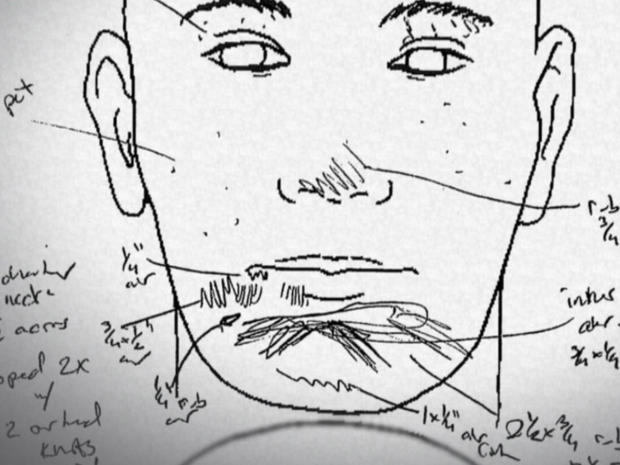 There was no body for him to examine, because Lloyd had Michele's remains cremated. But the pathologist saw that rope mark on Michele's chin and petechial hemorrhaging in her eyes. D.A. Brooks Baker: Then he leafs through a few more things, kind of the way doctors do in silence, and says, "This is a homicide." Michele Neurauter was strangled to death. Police headed out to confront Lloyd and Karrie. Erin Moriarty: I mean, at that point you're thinking Lloyd's the ring leader. D.A. Brooks Baker: No question. Erin Moriarty: Did you think that, if in fact Karrie Neurauter was involved, she was going to be the weak link? Chief Jeff Spaulding: I thought that she would be the weak link … You put her in an interview room without dad, without her cell phone, and you do a hard interview with her, I thought she would be the first to give. On Jan. 24, 2018, five months after Michele's death, two investigators showed up at Lloyd's office in New Jersey. At the same time, a pair of State Police troopers find Karrie at her college internship in Syracuse, New York. Erin Moriarty: Was this your Hail Mary pass? Was this it? Chief Jeff Spaulding: Yeah. That's what we considered game day Investigators break the news to Lloyd. D.A. Brooks Baker: And they say, "Lloyd, look … we gotta tell you something … the medical examiner has ruled this a homicide."
Chief Jeff Spaulding: And they suggested that "geez, Lloyd, maybe you want to take a lie detector test." Chief Jeff Spaulding: And to my surprise, he said, "Sure." So, they gave them directions to a police station down in New Jersey … where we had a polygraph operator that was already on call. Lloyd appeared confident in his innocence. Two-hundred miles away in Syracuse, Karrie was anything but. Erin Moriarty: Karrie cracks. D.A. Brooks Baker: Karrie cracks
There it was. In barely a whisper, on a police audio recording, Karrie admits her father went to her mother's house with her that night. And she helped him get in undetected:
Karrie said her mother stopped yelling and it suddenly got very quiet. At first, she tells New York State Police she didn't know why. But then she admits:
Chief Jeff Spaulding: it was one of those holy cow moments. It was like, "wow." Investigators then took Karrie to a police station. They wanted the whole story on video. She says her father came to her a week before the murder. D.A. Brooks Baker: She says that dad came to her … and says … I can't afford to pay your mother. There's no way out. … I have to kill myself. I'm sorry, you guys have to go on without me, or, I got plan B here!
Lloyd gave Karrie an unfathomable ultimatum:
She says Lloyd laid out his plan. They would make it look like a suicide:
Karrie says she stayed downstairs, watching over her younger sister asleep in the living room:
The commotion woke up Karrie's sister:
When Lloyd was finished, he sneaked out the back of the house, around the side, and climbed into the open rear hatch of Karrie's car. According to Karrie, her 14-year-old sister never knew her father was there.
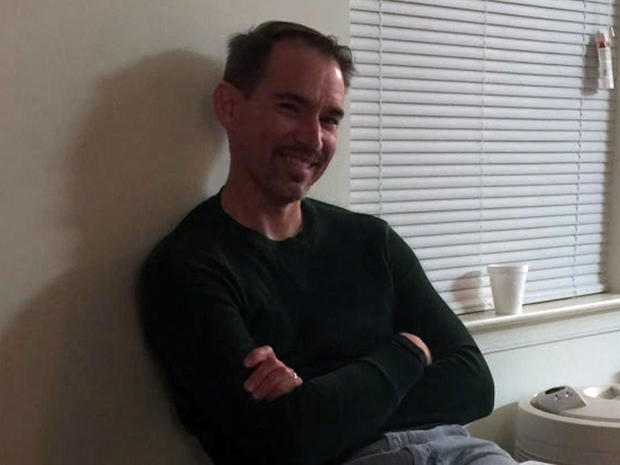 Police were now ready to arrest Lloyd. The only problem -- he never showed up for that polygraph test. He had disappeared. Erin Moriarty: They lost him. Chief Jeff Spaulding: They did lose him, but Lloyd still had his phone and we were still up on the wire on Lloyd's phone … We knew that his phone was in downtown Princeton somewhere. They managed to trace it to a municipal parking structure. And there on the roof was Lloyd Neurauter. Chief Jeff Spaulding: When the officers moved in to confront Lloyd and to pick him up, he bolted and hopped up on the rail and threatened to jump off the five-story parking garage to commit suicide. WAS KARRIE BRAINWASHED?For two hours, Lloyd Neurauter kept police at bay. When he turned his back, they made their move. 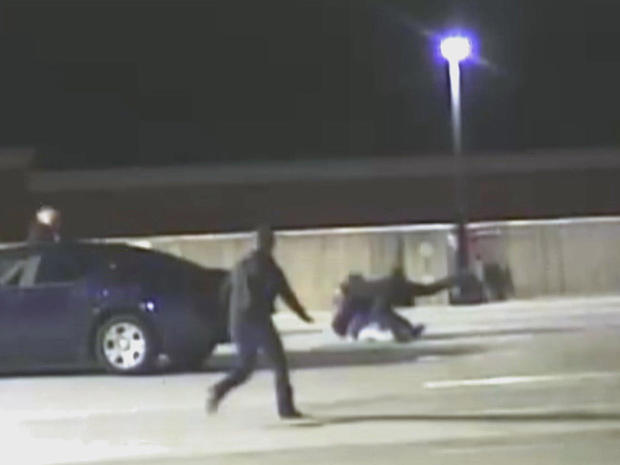 Chief Jeff Spaulding: This New Jersey state trooper who played football somewhere, he makes a 10-yard sprint and just flattens him, tackles him.
Lloyd was arrested and charged with first-degree murder of his ex-wife Michele Neurauter. Their daughter, Karrie -- who police believed had been manipulated by Lloyd – faced second-degree murder charges for helping her father get into the house that night. Erin Moriarty: What was your reaction when you heard that? Jeanne Laundy: Not, Karrie. … not Karrie. In February 2018, District Attorney Brooks Baker began preparations to face off in a courtroom. D.A. Brooks Baker [in war room]: This became essentially our nerve center, our war room for the trial. Erin Moriarty: This is not typical for the cases you usually try here. D.A. Brooks Baker: No. Even a murder case, usually we can survive in a box or two, but to go four or five boxes … is demonstrative how much material there was here. 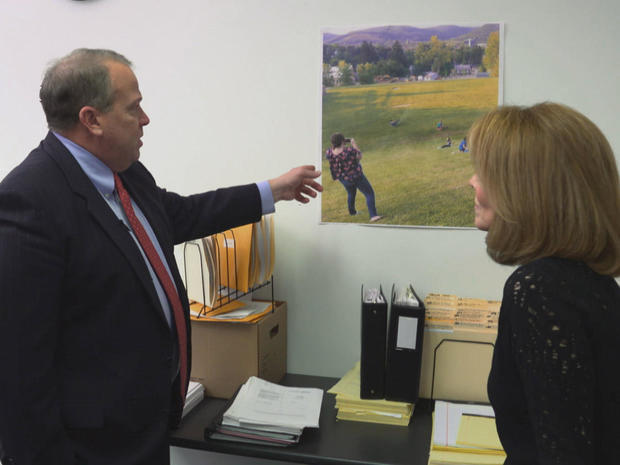 Erin Moriarty [pointing to a photo of Michele on the wall]: There's a reason why you have that up there, don't you? D.A. Brooks Baker: Yeah. … This is Michele's -- the final day of Michele's life. Erin Moriarty: It is? D.A. Brooks Baker: It is. … This is the Saturday she was murdered … This is a good day for them they went icing. And … they got … You can't really see it, but they're on great, big ice blocks. This reminds us why we're doing it. Because this lady's not here to have another day like this. Baker knows his odds of convicting Lloyd will greatly increase if he can convince Karrie to testify against her father. D.A. Brooks Baker: And she is looking at 15 years-to-life if she cooperates with the understanding that if she does not cooperate and is not truthful at trial she'll face 25 years-to-life. 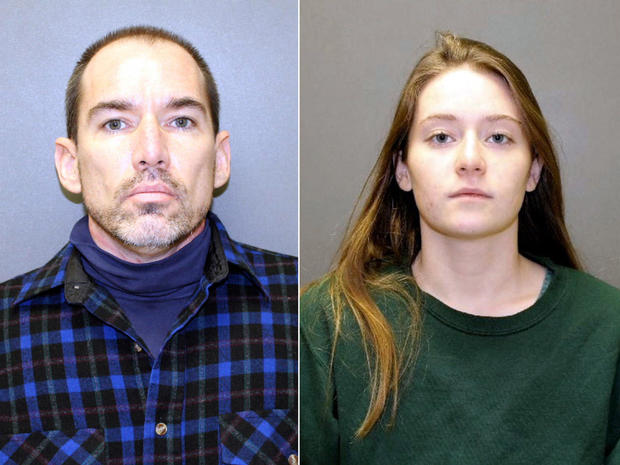 It takes Karrie, sitting in a jail cell, a couple of weeks to decide. She agrees to testify against her father and plead guilty. But then, during an interview with investigators, she surprises everyone, with a new detail:
Admitting for the first time she had an even bigger role helping her father cover up the murder:
Chief Jeff Spaulding: She laid her hands on her mother and felt her mother's cold dead body. … That's pretty hard-core. This is the woman that gave you life, and you maybe didn't directly take her life, but you helped the individual that did. It was so hard to understand. How could a child do this to her mother? Could Lloyd really have manipulated Karrie into this? D.A. Brooks Baker: And I had that same problem. … and even as we were preparing for trial … I said, "Karrie, you're going to be asked that question. … There was a moment when your father says to you, "It's either I have to kill mom or I kill myself and you have to help me… And those are the only two choices. And why?" Erin Moriarty: She's a smart girl … She could've said no. D.A. Brooks Baker: Well, and you know, all those folks in Jonestown could have said, "We're not going to drink the Kool-Aid." Erin Moriarty: You think she was brainwashed? D.A. Brooks Baker: I really think she was brainwashed. We found out that there is a definition for what he was doing. Erin Moriarty: And are you talking about parental alienation? D.A. Brooks Baker: Yes, I am. Parental alienation. It's when one parent consistently bad mouths the other in front of their children. And it's something Michele worried about. In fact, in court documents filed in the years preceding her death, Michele actually accuses Lloyd of turning Karrie against her. The district attorney thinks that's exactly what happened. Erin Moriarty: But I could understand how you could cause your children to dislike the other parent, but to kill … that other parent? That seems like a step too far. D.A. Brooks Baker: I don't think it's causing dislike, that's not what this parental alienation -- it causes them to absolutely devalue them as people. Case in point: two years before her death, Michele was backing out of her driveway while Karrie bickered with her and tried to block her car from leaving. Friends say, Lloyd then convinced Karrie that Michele tried to run her over. Karrie even called police on her mother. And while charges didn't stick -- Susan Betzjitomir: If you can brainwash your daughter into thinking that her inching out of the driveway … was your mother trying to run you over, then, "Well, she tried to kill you, so it's OK for you to help try and kill her." And when Lloyd later gave Karrie that ultimatum:
The D.A. says Karrie felt she had no choice but to choose her father over her mother. But would the jury believe it? As Lloyd's trial approached, the D.A. was determined to paint a picture of Karrie as Lloyd's pawn. But Lloyd had his own plans. Erin Moriarty: Is his defense gonna be that she did it? D.A. Brooks Baker: It has to be. LLOYD SURPRISES EVERYONEErin Moriarty: How much were you looking forward to trying Lloyd Neurauter for murder? D.A. Brooks Baker: You never look forward to a trial because it means 90 hours of work every week … This one I wanted to try. I wanted everybody to see who Lloyd was, and for Michele's sake, to see what he had done to her The evidence against Lloyd Neurauter was circumstantial. All the district attorney had was Karrie's word, and the jury might not believe her story. What he needed was physical evidence linking Lloyd to the murder of his ex-wife Michele. 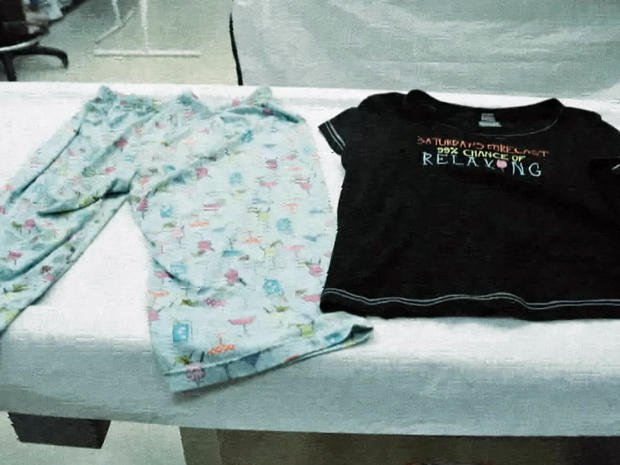 D.A. Brooks Baker: We took Michele's clothes, we had them re-examined by the state police, looking for touch DNA … When we got done, what we found was Lloyd's DNA … had contact with Michele's clothing -- the pajamas she was wearing the night she was murdered. Prosecutors gave Lloyd the damning news and a final opportunity to come clean. D.A. Brooks Baker: We made to him an offer I sort of expected he would never, ever accept. He had to plead guilty as charged to first-degree murder … he would face a sentence of … 25 years-to-life with the possibility the judge can sentence him to life without parole. Just two weeks before trial … Erin Moriarty: So, what did Lloyd decide to do? D.A. Brooks Baker: He decided to plead guilty. 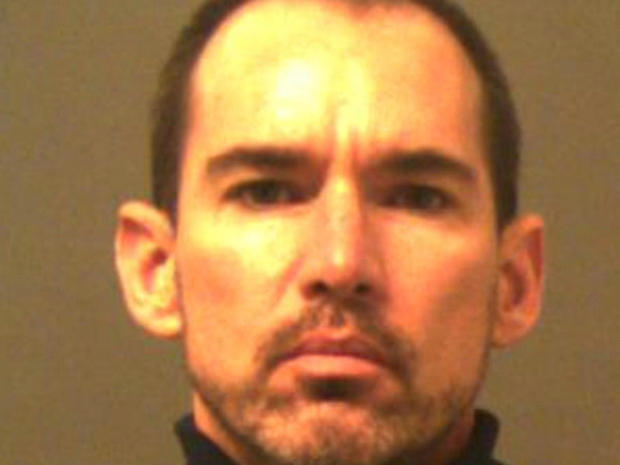 As part of his plea deal, Lloyd had to recount his role in the murder. But when it came time to take personal responsibility … D.A. Brooks Baker: I thought we were gonna go bad from minute one, 'cause he starts off blaming Michele. There were no cameras in the courtroom. But Lloyd tells the judge he killed Michele because he believed she might hurt their children. Jeanne Laundy: That would be Lloyd, blame everybody else, blame the victim. D.A. Brooks Baker: But then, he sort of said, "But that doesn't matter. I have no excuse. Murder is wrong." And, and he went through and allocuted line by line of what he did. In the end, Lloyd fulfilled his end of the plea deal, admitting he planned and carried out the homicide and that he manipulated Karrie into helping him. Erin Moriarty: So what should happen to him? Jeanne Laundy: I want him to have life in prison. I don't want him to ever get out, and never hurt my grandchildren again. He has an evil mind. Michele's mother, Jeanne Laundy, spent days writing a statement she hopes will persuade the judge to give Lloyd a stiff sentence. She read it to "48 Hours:" Jeanne Laundy [reading]: Lloyd Neurauter abused and tortured my daughter for 25 years. … He coerced his own daughter into helping him kill her mother … Karrie is now in jail … facing the possibility of years in prison … Lloyd Neurauter should never be given the opportunity to harm anyone again. Please, Your Honor, give him life without parole. And that's exactly what the judge would do.
But there was still the matter of Karrie, and what price should she pay for her mother's death. Erin Moriarty: That's a harder one isn't it? Jeanne Laundy: That's a hard one. I don't believe she should go to prison. … I think that she needs psychiatric help. I think she needs a lot of therapy, District Attorney Brooks Baker would agree. Karrie needed therapy, but he didn't think that would be enough. D.A. Brooks Baker: She has to pay a price. She has to serve a sanction. I think for her own sanity, she needs to serve some penance. Remember, Karrie initially pleaded guilty to second-degree murder, a charge that could put her in prison for 15 years. But the D.A. supported a decision allowing her to now plead guilty to a lesser charge, second-degree manslaughter. Laundy again wrote to the judge: Jeanne Laundy [reading letter]: I always ask myself, "What would Michele want me to do?" I do not believe my daughter, Michele, would want a long prison sentence for her daughter. … She would want her to eventually lead a happy life.  And the judge would be lenient -- very lenient. Karrie Neurauter was sentenced one to three years in a state prison. It's a huge relief to Laundy. With time served, Karrie may not be locked up for very long. And when Karrie's released, Laundy plans to tell her and her two sisters all about Michele and just how much she loved them. Jeanne Laundy: She knew that she had lost them … the two oldest. And she wanted them to be happy, and she hoped that someday they would realize what was done and come back to her and see how hard she fought … for them to have a good life. … She wanted to live a beautiful life, to have a beautiful life, and for them to be happy. Shortly after her sentencing in December 2018, Karrie Neurauter went before the parole board. Her parole application was denied. She will be eligible to apply again in February 2020.  |
| Inside the Black Mirror World of Polygraph Job Screenings - WIRED Posted: 01 Oct 2018 12:00 AM PDT .jpg) Christopher Talbot thought he would make a great police officer. He was 29 years old, fit, and had a clean background record. Talbot had military experience, including a tour of Iraq as a US Marine, and his commanding officer had written him a glowing recommendation. In 2014, armed with an associate degree in criminal justice, he felt ready to apply to become an officer with the New Haven Police Department, in his home state of Connecticut. Talbot sailed through the department's rigorous physical and mental tests, passing speed and agility trials and a written examination—but there was one final test. Like thousands of other law enforcement, fire, paramedic, and federal agencies across the country, the New Haven Police Department insists that each applicant take an assessment that has been rejected by almost every scientific authority: the polygraph test. Commonly known as lie detectors, polygraphs are virtually unused in civilian life. They're largely inadmissible in court and it's illegal for most private companies to consult them. Over the past century, scientists have debunked the polygraph, proving again and again that the test can't reliably distinguish truth from falsehood. At best, it is a roll of the dice; at worst, it's a vessel for test administrators to project their own beliefs. Yet Talbot's test was no different from the millions of others conducted annually across the public sector, where the polygraph is commonly used as a last-ditch effort to weed out unsuitable candidates. Hiring managers will ask a range of questions about minor crimes, like marijuana use and vandalism, and major infractions, like kidnapping, child abuse, terrorism, and bestiality. Using a polygraph, these departments believe, increases the likelihood of obtaining facts that potential recruits might prefer not to reveal. And like hundreds of thousands of job candidates each year, Talbot was judged to have lied on the test. He failed. New Haven allows failed applicants to plead their case in public before the Board of Police Commissioners. So in February 2014, Talbot sat down and recited his experiences with lie detectors. He had first applied to the Connecticut State Police and was failed for deception about occasional marijuana use as a minor. He then tried again with a police department in New Britain, where a polygraph test showed him lying about his criminal and sexual history. This time he had failed the New Haven polygraph for something cryptically called "inconsistencies." "[But] I'm not hiding anything," he said at the hearing. "I was being straight and honest and I've never been in trouble with the law. I'm not lying about anything." Electronic lie detection is a peculiarly American obsession. No other country carries out anywhere near the estimated 2.5 million polygraph tests conducted in the US every year, a system that fuels a thriving $2 billion industry. A survey by the Bureau of Justice Statistics from 2007 found that around three-quarters of urban sheriff and police departments use polygraphs when hiring. Each test can cost $700 or more. Apply to become a police officer, trooper, firefighter, or paramedic today, and there is a good chance you will find yourself connected to a machine little changed since the 1950s, subject to the judgment of an examiner with just a few weeks' pseudoscientific training. Last week the technology burst into the news when Christine Blasey Ford, the woman who accuses Supreme Court nominee Brett Kavanaugh of sexually assaulting her as a teenager, said that she had taken a privately administered polygraph test to help bolster her account of the incident. "While not admissible in court, they're used by various governmental agencies and many people believe in their abilities," Douglas Wigdor, a former prosecutor who now represents victims in sexual harassment and sexual assault cases against high-profile men, told The Washington Post. In one of the biggest surveys of law enforcement use of polygraph screening to date, WIRED filed more than 50 public-records requests with America's largest federal, state, and local law enforcement agencies, seeking to discover how they use the polygraph during hiring and what safeguards they have in place to prevent abuse. The results were erratic—and discouraging. A quarter failed to respond at all, and nearly half said they had no responsive documents— meaning they do not track the age, gender, race, or disability status of those undergoing examination. But the results obtained offer a peek inside an outdated system that continues to influence who gets hired—and who doesn't—at some of the most important institutions in the United States. Inconsistent and skewed polygraph screening programs are undermining the very places that are designed to uphold the law—a failure that comes with personal costs. Lie detection has come a surprisingly short way from its inception a century ago. As a graduate student at Harvard in 1915, American psychologist and proto-feminist William Marston noticed that when his wife "got mad or excited" her blood pressure seemed to climb. He theorized that measuring her blood pressure while asking her questions could reveal deception by pinpointing the answers that caused a spike. With the United States' entry into World War I, Marston approached various government departments with the idea of developing his system as a tool to trap spies. He eventually secured a position in a medical support unit of the War Department (the precursor to the Department of Defense), where he carried out his initial research, often using women in university sororities as subjects. After the war, Marston trained his focus on the legal system. In 1921, James Frye, a black man in Washington, DC, was accused of shooting a doctor. Frye confessed the crime to police, then a few days later recanted his confession. Frye's lawyer brought in Marston to test his client's honesty. At the time, Marston's device was a hack: a basic blood pressure monitor, administered with a medical cuff and stethoscope. After subjecting Frye to an examination, he concluded that his story of innocence was entirely truthful and agreed to testify on his behalf. However, the judge objected to the use of an unknown and unproven tool. An appeals court agreed, writing, "The thing from which [a] deduction is made must be sufficiently established to have gained general acceptance in the particular field in which it belongs." This became known as the Frye standard. Because polygraphs have never convinced the majority of scientists, the Frye standard has excluded them from most courtrooms for almost a century. The experience only fueled Marston to make his method more sophisticated. He began working with a device, soon dubbed the polygraph, that measured blood pressure, breathing rate, and skin conductance—aka sweatiness. With some electronic and digital upgrades, these are essentially the same devices in operation today. Marston was media-savvy, touting polygraph technology in a public advertising campaign and, ultimately, even in comic books. While working as a consultant to DC Comics in 1940, Marston proposed a female superhero, Wonder Woman. She would be strong and smart, armed with bulletproof bracelets and an unbeatable lie detector—a Lasso of Truth that prevented anyone within its golden orbit from lying. In reality, Marston's design was far from perfect. Mainstream psychologists were concerned that the physiological responses the polygraph recorded could be caused by a host of things other than deception; the device might capture unrelated emotions, such as nervousness, arousal, anxiety, or fear. And once you have results, their meaning is open to interpretation. A polygraph only records raw data; it is up to an examiner to interpret the data and draw a conclusion about the subject's honesty. One examiner might see a blood pressure peak as a sign of deception, another might dismiss it—and it is in those individual judgments that bias can sneak in. But regardless of a polygraph's accuracy, some organizations were beginning to find it useful. The polygraph's scientific aura gave police a tool to intimidate suspects and recruiters a convenient way to shape their workforce. By the middle of the 20th century, polygraphs were being used by government agencies, factories, and banks to screen employees and investigate crimes, with little control or oversight. During the Cold War, federal polygraph tests were used to target left-wingers and homosexuals in government agencies. Eventually, science began pushing back. In 1965, the US Committee on Government Operations evaluated the scientific evidence for polygraphy and concluded: "There is no lie detector, neither man nor machine. People have been deceived by a myth that a metal box in the hands of an investigator can detect truth or falsehood." The next year, the American Polygraph Association was formed to promote polygraphy and provide standards for examiners and technologies. In 1988, after years of intense lobbying by unions, the Employee Polygraph Protection Act prohibited most private companies from using lie detector tests. But the unions did not get a clean sweep: The Act excluded federal, state, and local government employers, along with private companies whose business is moving cash or drugs. The American Medical Association had come out against pre-employment screening in 1986, and in 1998 the Supreme Court also chipped in, saying that there was simply no scientific consensus that polygraph evidence is reliable. In 2004 the American Psychological Association said "the lie detector might be better called a fear detector," noting there was virtually no research validating its use in job screening. In 1999 the Department of Energy asked the National Academies of Science to review the scientific evidence of the validity and reliability of polygraph examinations, particularly as used for screening. The resulting committee visited governmental polygraph units and reviewed almost a century of scientific papers and data. Its comprehensive report, which took four years to research and write, was damning. "Almost a century of research ... provides little basis for the expectation that a polygraph test could have extremely high accuracy," wrote its authors. "Polygraph testing yields an unacceptable choice between too many loyal employees falsely judged deceptive and too many threats left undetected. Its accuracy in distinguishing actual or potential violators from innocent test takers is insufficient to justify reliance on its use in employee screening." In short, the technology was judged to be pseudoscientific hokum. It was the polygraph's tendency to produce false positives that especially worried the Department of Energy. Imagine using a polygraph in an investigation like the one proposed by US senator Rand Paul to identify the author of a damaging anonymous New York Times op-ed earlier this month. If a polygraph is accurate 85 percent of the time, as some data suggests, an investigation of 100 White House senior officials might well identify the guilty individual, but at the cost of falsely accusing 15 others. Shift that accuracy to 65 percent, a figure many critics suggest, and you couldn't even be certain your culprit would be among the 34 individuals the machine would accuse. In 2005, the Department of Energy report concluded that "false positives … clearly affect the morale of those for whom such a result is reached. They risk interrupting the careers of valuable contributors to our nation's defense [and] pose a very serious risk of depriving the United States of the vital services of individuals who may not be easily replaced." Christopher Talbot would never become a New Haven police officer. Despite his heartfelt plea, the commissioners voted unanimously to remove him, and dozens of other candidates, from consideration. Alex Petrowsky Of course, Talbot may in fact have been guilty of a lie or crime for which there was no other proof. But evidence amassed by WIRED suggests an equally likely explanation: that he was the victim of a flawed and unreliable technology that is also vulnerable to examiners' own personal prejudices. Data obtained by WIRED showed vast differences in the outcomes of polygraph tests depending on the examiner each candidate faced. Consider another law enforcement agency that uses polygraphs in its employment process: the Washington State Patrol (WSP). Between late October 2011 and the end of April 2017, the WSP conducted 5,746 polygraph tests on potential recruits. This was the largest data set WIRED received, including copious data on both applicants and examiners. While one examiner failed less than 20 percent of candidates, others failed more than half the applicants they screened. And while two examiners disqualified just four people in more than 1,000 applicants for supposedly having sex with animals, one of their colleagues failed more than 10 times as many for bestiality—around one in 20 of all job seekers. The same examiner was also twice as likely as the rest of his peers to fail applicants on the grounds of child pornography. There were no further hearings for these supposed crimes, and no jury to convince or judge to adjudicate, just scores of otherwise qualified applicants who would now not become Washington state troopers. "We don't know which, if any, of the examiners are accurate, but the disparity between them suggests the test is not being used in a way that is at all reliable," says John Allen, a professor of psychology at the University of Arizona. And tests that are not reliable, Allen says, cannot be valid. Not only can a failing polygraph test cost you a job, it can also follow you around throughout your career. People who fail a polygraph are usually asked to report that fact if they reapply for law enforcement positions nationwide, and some departments can share polygraph results with other agencies in the same state. "The polygraph's great flaw is the substantial number of false positives that it gives out, especially when you're using it for large-scale screenings," says former CIA director James Woolsey, in a previously unreleased interview from 2009. He believes that polygraphs do not accomplish much more than "seriously damaging a lot of people's lives by having them fail the polygraph when they haven't really done anything." This is not just a problem in Washington state. Around the US, most police departments use similar test formats and near-identical lists of questions, yet polygraph pass rates vary wildly. According to data supplied to WIRED, the toughest place in the country to take a polygraph could be Houston, whose police department passed just 32 percent of applicants in 2009. More recently, less than half (47 percent) of applicants passed the San Diego Police Department's polygraph test in 2017. Slightly more lenient is the Texas Department of Public Safety in Austin, which passed 60 percent in 2016. But if you fail there, you could try again down the road at the Dallas Police Department, where 77 percent of test-takers passed last year. And if the thought of all those wires and dials really gets you nervous, head to Baltimore, where more than 91 percent of applicants aced the polygraph in 2017. Despite similar tests and presumably similar applicants (especially in Texas), the departments' pass rates are wildly different—and these rates have varied little over multiple recent years. But while polygraph examinations can be a lottery, history seems to show that the house can sometimes tip the odds. Forty years ago, Harold Moon applied for a position as a correctional officer in Cook County, Illinois. After taking a polygraph test, Moon, who was black, was informed that he had failed and was rejected. Moon then brought a class action suit alleging discrimination in violation of the 1964 Civil Rights Act. His suit included analysis that there was only a one in 1,000 chance of the high polygraph failure rate among black applicants in Cook County between 1976 and 1978 being random. The Congressional Record in 1987 noted that Moon's case was quietly settled, including an agreement with Cook County to eliminate the polygraph requirement. That agreement would probably come as news to Donna Bibbs and two other African Americans who filed their own Civil Rights Act lawsuit against Cook County and its Sheriff's Department in 2010. Bibbs and her fellow plaintiffs alleged that they were rejected for employment because of confessions given during their polygraph examinations that were never actually made. "The Sheriff has not adopted any procedure to allow applicants to dispute the correctness of reports of admissions on the polygraph examination," read their complaint. "A consequence of [this] is to vest the polygraph examiner with the final authority to reject applicants by making false reports of admissions." This case never made it to court either; the parties eventually reached a settlement in 2016. There is no indication that Cook County has since altered any of its policies, and, in fact, the Sheriff Department's legal department told WIRED that it does not retain polygraph records in an aggregate format, rendering it unable to track systematic racial bias. From WIRED's public records requests, it appears that few jurisdictions retain these records, making it nearly impossible to systematically identify bias in their programs. That comes as no surprise to William Iacono, professor of psychology, psychiatry, neuroscience, and law at the University of Minnesota. "[Demographic data] sounds like something these organizations don't want to have," he says. "Because if they have it, and someone asks for it, then it might reveal something that they're not comfortable with. The examiner doesn't really use an algorithm to figure out if people are employment worthy. The examiner's decision is probably based primarily on the human interaction that the two people have." In a survey of Virginia's state licensed polygraphers carried out by University of Virginia researcher Vera Wilde in 2011, roughly 20 percent of respondents said they thought certain groups (for example, black people) tended to fail polygraphs more than others. In a US Senate hearing in 1987, the attorney general for New York said, "The [polygraph] operator's prejudices, moods and feelings can strongly influence and even determine the outcome of the test. For example, we have received complaints about a polygraph operator who consistently fails a much higher percentage of black subjects than white subjects." A study carried out for the Department of Defense's Polygraph Institute in 1990 showed that innocent black polygraph examinees were more likely to suffer false positives than innocent whites, under mock crime conditions. The National Academy of Sciences report in 2003 worried about possible race, age, and gender biases, but noted that little research had been done in the area. "We know that there's a potential effect of gender [and] race, in terms of [the] mix of polygrapher and subject," said NAS committee chairman Stephen Fienberg in 2009. "We know that context matters. And we know that there can be systematic biases." In 2007, a federal court observed that black applicants to the Arkansas State Police one year failed polygraphs at twice the rate of white applicants, although the numbers were too small to draw firm conclusions. Dozens of equal opportunity complaints have been made against the FBI's polygraph screening unit, accusing examiners of racial and other biases. Many of the complaints, released to Wilde under Freedom of Information laws, reveal applicants' frustrations with an opaque and seemingly hostile process. In 2008, one failed applicant wrote: "Black females are subjected to an entirely different level of scrutiny. I was given a polygraph test in Memphis and told that I failed, which was given by a male white. I requested a retake and was told that I passed the second polygraph test taken in Nashville, TN., which was given by a male black." The FBI recorded her as saying its hiring criteria were "preset for hiring white males." Both her application and her subsequent complaint were denied. While undergoing a polygraph examination for a position at an FBI field office in New Haven in 2010, a black man was told that his recollection of using marijuana only a few times in high school was showing as deceptive, and that he should change his answer. Later, he wrote: "I was convinced that [the examiner] may have made an assumption, based on a stereotype about African Americans and drug use, and used that stereotype to profile me. I also realized that what [he] was asking of me would reflect negatively either way—if I didn't change my answer I was being deceptive, and if I did change my answer I was lying on my application." This catch-22 grievance was investigated by the Department of Justice's Complaint Adjudication Office in 2012. That office noted that the FBI had another polygraph examiner review the case blind, with "no information concerning complainant's race." However, the FBI's definition of a blind review demands some scrutiny. The second examiner wrote that "the only personal information available to him when conducting the review was complainant's name, date of birth, social security number, gender, height, weight, and address." The controversy around so-called redlining has shown repeatedly that race and zip code (and even names) are closely linked. The man's complaint was ultimately dismissed, as were all the other complaints obtained by Wilde. The FBI rejected multiple requests from WIRED under the Freedom of Information Act for the demographics of applicants failing its polygraph screening tests, citing exclusions for law enforcement and national security data. However, the agency accidentally included relevant (but incomplete) data in a response to Wilde in 2012, not published until now. The New Haven discrimination investigation included a memo stating the racial backgrounds of 130 FBI applicants who had failed preemployment polygraph tests between October 2008 and June 2010. (An additional 2,130 applicants who failed the polygraph were listed as "race unknown.") While 12 percent of FBI staff are black, 19 percent of those failing its polygraph tests were black. Asians, Hispanics, Native Americans, and Pacific Islanders were also overrepresented in those failing the polygraph. And although 75 percent of FBI workers are white, they made up just 57 percent of applicants failing the polygraph tests. New data collected by WIRED show that local police departments fare little better. The Metropolitan Nashville Police Department uses a computerized voice stress analyzer (CVSA) in place of a polygraph. This is a machine that supposedly detects deception by analyzing the low frequency audio information from answered questions about sensitive topics—some systems purport to detect "micro tremors" in deceptive answers. The technology is regarded with as much skepticism in the scientific community as polygraphs. Data supplied to WIRED by the Metro Nashville Police Department show that black applicants are selected at only about half the rate of white applicants, and that Hispanic and Native American officers are also significantly under-selected. Metro Nashville also selects younger candidates (up to age 39) at nearly twice the rate of older ones (40 or older). The department says it has no record of anyone making an age, gender, or race-related complaint about the CVSA test, and that no applicant is ever disqualified based on a CVSA result alone. Although a voice stress analyzer test is only one part of Metro Nashville's hiring process, there is some evidence that lie detector screening contributes more directly to lopsided hiring practices elsewhere. The Baltimore Police Department might have a relatively lenient polygraph screening system, passing the vast majority of those applying, but black applicants from 2013 through 2017 still failed their polygraph tests at higher rates than their white counterparts. In 2016 and 2017, they failed more than twice as often. Discrimination can work the other way too, if departments are giving preferred candidates a second shot at passing a test. In a 2014 internal survey of the San Diego Police Department's polygraph unit, supplied to WIRED, one police officer noted: "I feel the examiners do a good job … They always offer to re-test if we want to." This calls into question whether all applicants are treated equally, and suggests that even some police officers suspect the test is not always accurate. While the 2003 National Academy of Science report removed the last vestiges of polygraphy's scientific credibility, researchers continue to track the technology's real-world use. A 2017 study at Walden University in Minneapolis found no relationship between preemployment polygraph exams and officers' propensity for future misconduct—a purported justification for administering polygraphs—nor any differences in attitude toward misconduct between officers who had or had not undergone such testing. "The research we've done shows that there's no higher level of misconduct among police departments that don't give polygraphs to applicants [than among] ones that do," says Daryl Turner, president of the Oregon Coalition of Police and Sheriffs, an association of law enforcement professionals that campaigned against a bill last year to introduce preemployment polygraph screening in the state. "We also feel [the polygraph test] is not a fair assessment of a person's truthfulness or integrity." That is not a view shared by the American Polygraph Association, which certifies polygraph schools across the country. The majority of law enforcement agencies using polygraphy require examiners to be graduates of an association's polygraphy course, which costs around $6,000 and can take 10 weeks to complete. The Washington State Patrol says that all of its examiners are APA certified, carry out polygraph tests consistently, and check results with colleagues. Despite that, data supplied to WIRED shows that the WSP hires black men at a lower rate than white men, and is more likely to fail older candidates during its polygraph screening. WSP lieutenant John Matagi could not offer a good reason why its examiners failed applicants or uncovered crimes at different rates, except to say: "They're humans making human decisions [and] as each polygraph examiner gets better at their skill, they will have different results." He also brushes off concerns that older candidates fail more often. "One of the things we speculated is that people who have been alive longer have more opportunity to engage in activity that is disqualifying," he says. Other departments appear more concerned about possible inequities. The Dallas Police Department supplied WIRED with data on the gender and race of its applicants and their relative success in polygraph tests. It also compared each group to the majority demographic of applicants. (As in every department that gave data to WIRED, this was white males.) Dallas reported more equitable hiring outcomes, and less variation between different groups, than other departments that responded: Both genders and all racial groups passed at similar rates. So if the polygraph is so unreliable and prone to bias, why does law enforcement continue to use it? WSP's Matheson says that much of the value in polygraph testing comes during the pre-polygraph interview, where "it is not uncommon for us to learn information that disqualifies the candidate. That's a big part of the value of what we hope to gain from the entire process." In other words, the mere specter of being subjected to a lie-detector test can induce applicants to confess information they might have otherwise withheld. Between 2010 and 2017, the Phoenix Police Department told WIRED that it conducted 3,711 polygraph tests while recruiting sworn officers, civilian staff, interns, and volunteers. On 96 occasions, applicants admitted to crimes during or after their test, including two confessions of extortion—and four of murder. Although the polygraph cannot reliably detect truth or falsehood itself, its cultural reputation for omniscience can be used by an artful examiner to elicit confessions from nervous or suggestible subjects. "The one thing that lie detection appears to be good for is tricking naïve people into thinking that the person who's examining them knows more about what's in their mind than they actually ever could," says Jay Stanley of the American Civil Liberties Union's Speech, Privacy, and Technology Project. "It's an intimidation device." The polygraph industry does not always get its way. The ACLU and the Oregon Coalition of Police and Sheriffs succeeded in fighting off the attempt to legalize polygraph screening tests in Oregon last year, and evidence obtained using a polygraph remains inadmissible in most legal settings. Even the New Haven Police Department, which continues to use the polygraph for screening recruits, has proposed shifting their standards around the test. Earlier this year, the New Haven mayor's Police and Community Task Force noted that minority officers are underrepresented in the department and laid part of the blame for that with the polygraph screening process. "NHPD needs to create a policy prohibiting contact between the psychologist and recruitment staff and the person administering the polygraph test," it wrote in a report. According to the best available science, polygraph tests are no more reliable at extracting the truth than Wonder Woman's magic lasso. But by the time a new installment of the super hero's story is released, in November 2019, millions more polygraphs will have been administered across the nation. More Great WIRED Stories |
| Mike Pence Swears His Loyalty on the Sunday Shows - The Atlantic Posted: 10 Sep 2018 12:00 AM PDT  By all rights, Brett Kavanaugh's dramatic confirmation hearings should have been the big story last week. But if the Sunday shows are a reliable barometer, the Senate Democrats' concerted, if mostly ineffectual, assault on the very conservative D.C. appellate-court judge couldn't compete with Bob Woodward's incendiary new book, Fear, or the New York Times op-ed by an anonymous Trump administration official who thinks the president is unfit to govern. The shows kept wending their way back to the "quiet resistance" inside the administration, from Woodward's report of Defense Secretary James Mattis ignoring President Donald Trump's order to assassinate Syria's dictator to the anonymous op-ed author's description of Trump's sullen resistance to more sanctions after Russia poisoned an ex-spy in Britain. Guests on the shows included Vice President Mike Pence, the Trump adviser Kellyanne Conway, former Governor Chris Christie of New Jersey, and Democratic Senators Dick Durbin, Mark Warner, and Chris Coons. Pence predictably condemned the anonymous column as "un-American" and an "assault on our democracy." Speaking on Fox News Sunday, he said he does not know who wrote the piece but suggested that person should leave the administration. His less predictable response came when the host, Chris Wallace, asked whether top officials should submit to lie-detector tests to prove they did not write the op-ed. "I would agree to take it it in a heartbeat," the vice president said. Let's make note of this moment: The No. 2 elected official in America publicly proclaimed his readiness to take a polygraph test to verify his loyalty to the president. Imagine Joe Biden strapping on a blood-pressure cuff for Barack Obama, or Dick Cheney wearing velcro rings to measure his pulse for George W. Bush. Pence said on Face the Nation that he was positive the op-ed didn't come from someone on his staff, even without administering lie-detector tests. "I don't have to ask them," he said. "I know their character." The host, Margaret Brennan, also asked the vice president whether he'd ever been in a conversation about using the Twenty-Fifth Amendment to remove President Trump from office. (Another moment to take note of.) "No, never. And why would we be?" Pence said before pivoting to tout the administration's accomplishments. Christie took a different tack on ABC's This Week, where the former governor and Trump-campaign surrogate is now a network contributor. Wearing a bright-pink tie and looking into the camera with a thousand-yard stare, Christie seemed to be performing for the president, whose 18-month-old administration has yet to include him. He argued that the op-ed's author couldn't really be a senior official, since Cabinet members and other top officials have issued denials. (CNN has a list of op-ed deniers, updated as of Saturday.) He seemed to be quibbling over the definition of senior, which could plausibly apply to hundreds of administration officials. President Trump, in comments and in a one-word tweet last week, has posed the question of whether the author committed treason. Federal law defines treason as going to war against the United States or giving aid to its enemies. Several hosts asked administration officials how the anonymous op-ed could possibly match that description. When asked by Chuck Todd on Meet the Press, the senior counselor and veteran spinmeister Kellyanne Conway offered impossible-to-disprove hypotheticals: "How do we know they haven't promised other things? How do we know they're not taking other documents?" When Todd asked how there could be any broken laws for prosecutors to investigate, she replied, "It depends. There could be, and there could not be." But Conway also said, "Nobody's investigating the op-ed." Pence didn't defend the idea that anonymous public dissent could constitute treason, but he said the op-ed was an "assault on American democracy" because it showed a government official trying to thwart the will of an elected president. Though Pence chided former President Obama for publicly criticizing his successor in a speech Friday, Obama had voiced a similar view of anonymous Trump administration officials promising a quiet resistance. "That's not how our democracy is supposed to work," Obama said in the same speech. "These people aren't elected. They are not accountable." The Senate's No. 2 Democrat seemed to concede that there was a problem with an aide undermining a president. Todd asked Senator Dick Durbin of Illinois whether the president deserves a staff that doesn't try to impede his agenda. "Well, of course," Durbin said, before quickly handing blame to Trump for running a dysfunctional White House and leading his own aides to believe "his behavior is going to result in some terrible things for America." Senator Chris Coons of Delaware agreed with Pence on a key point on Fox News Sunday but framed it differently: "I think the honorable thing to do is to resign and to go public with the author's concerns about the president's fitness to serve." Senator Mark Warner of Virginia, the top Democrat on the Senate Intelligence Committee, agreed with Republicans that the op-ed author should go public and reveal his or her identity. But he blasted Trump's open criticism of the Department of Justice, including over the recent indictments of two GOP congressmen within a few months of an election: "Does this president not understand that the Justice Department is not a tool of his own personal power?" We want to hear what you think about this article. Submit a letter to the editor or write to letters@theatlantic.com. Andrew Kragie is a writer based in Washington, D.C.  |
| You are subscribed to email updates from "polygraph definition" - Google News. To stop receiving these emails, you may unsubscribe now. | Email delivery powered by Google |
| Google, 1600 Amphitheatre Parkway, Mountain View, CA 94043, United States | |


Comments
Post a Comment